
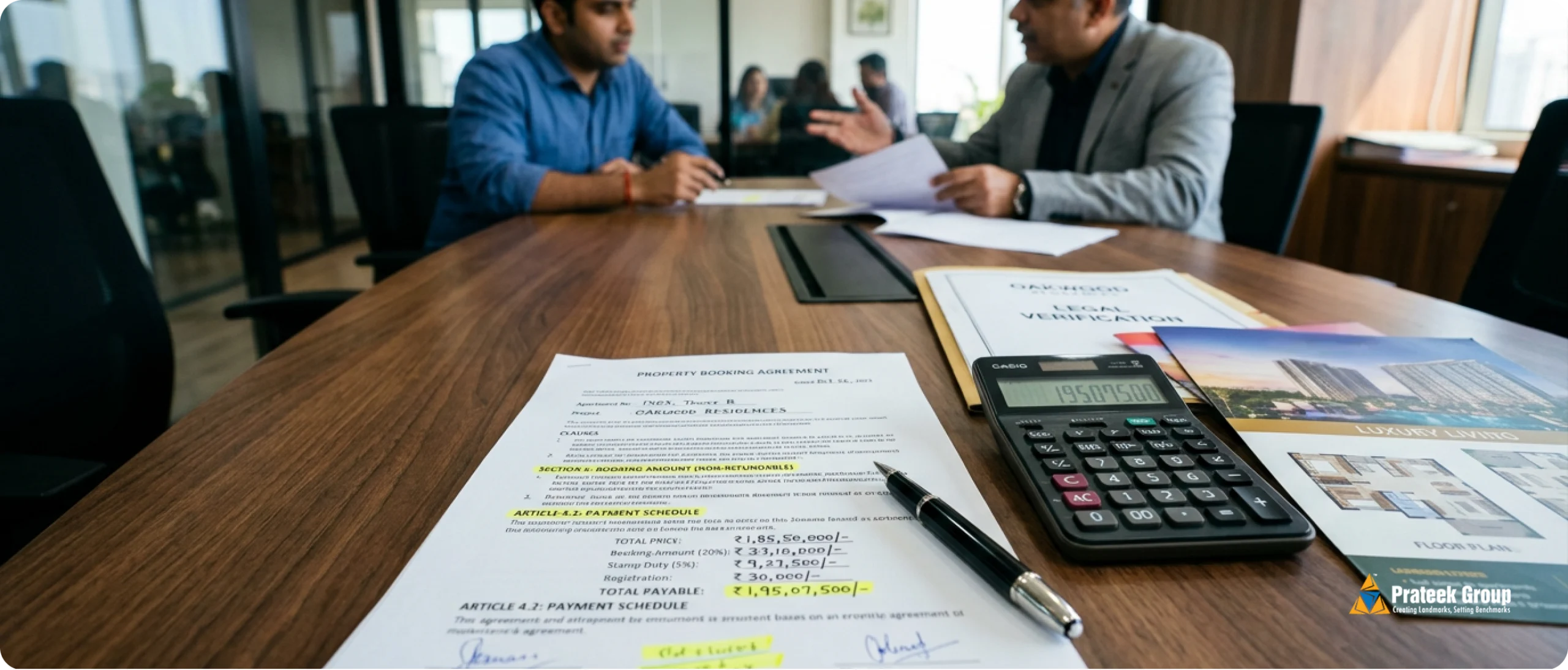
The Revised Cost Sheet That Makes Buyers Pause
A family books a 3 BHK in Greater Noida West after 2 site visits and a long discussion at the sales office. The quoted price fits their loan plan. The family pays the booking amount, receives the receipt, and waits for the allotment letter.
A few days later, the builder sends a revised cost sheet with a higher total. The base price has changed, one fresh charge has appeared, and the loan calculation no longer looks comfortable. This is usually when a buyer starts searching for builder increased flat price after booking and tries to understand whether the new amount is backed by documents.
For many NCR buyers, the stress comes from timing. The loan file may already be moving. The buyer may have stopped checking other projects. The family may have trusted the sales team because the price was presented as time-bound. Once a new figure appears, the buyer needs paperwork before emotion takes over.
The first check is the project record. A Noida, Greater Noida, or Ghaziabad buyer should compare the project name, promoter name, registration number, and completion date through UP RERA project details before discussing a fresh demand with the builder. A Gurugram, Sohna, or Faridabad buyer should use the Haryana RERA route. A Delhi buyer should use Delhi RERA records where the project is registered there.
This is where the main question comes in: can a builder increase flat price after booking? The answer depends on what has already been written, signed, paid, and disclosed. A verbal quote, booking form, allotment letter, cost sheet, demand letter, and builder-buyer agreement do not carry the same weight.
The buyer should line up all documents before replying. The booking form may show the first price understanding. The allotment letter may show the unit, area, payment plan, and charge heads. The builder-buyer agreement may show whether a price escalation clause exists. The demand letter may show the reason for the extra amount.
NCR property buyer rights become practical when the buyer knows which document to open, which amount to compare, and which RERA portal applies to the project. That clear paper trail is stronger than a phone call or a sales-office assurance.
Can A Builder Increase Price After Booking?
When a builder increases price after booking, the answer depends on the project location, booking form, allotment letter, cost sheet, payment plan, builder-buyer agreement, RERA registration details, and the reason given in the demand letter.
A flat price increase after booking needs closer checking when it changes the base flat price already written in the documents. A different check applies for GST, stamp duty, registration, delayed payment interest, carpet area variation, PLC, floor-rise charge, parking, club, IFMS, or maintenance advance. Some charges may be payable if they were already disclosed, arise from tax or authority demand, or follow a written agreement term. The buyer can still ask for proof.
RERA gives buyers an early safeguard on large advance payments. A promoter cannot accept more than 10% of the apartment, plot, or building cost as advance payment or application fee before entering into a written Agreement for Sale, so buyers should read the RERA booking rules before treating a post-booking demand as final.
Verbally Discussed Price
If the price was discussed only at the site office or over a call, the buyer’s position can be weaker. Still, every WhatsApp message, brochure, payment receipt, email, and first cost sheet should be saved. These records can help show what was represented before booking.
Price Written In The Allotment Letter
Once the allotment letter records the unit number, area, total cost, payment plan, and charge heads, the buyer has a stronger document trail. If the builder later changes the base price, ask the builder to point to the clause that permits the change. A broad price-revision line needs to be read with the whole document.
Agreement Already Signed
The builder-buyer agreement or Agreement for Sale becomes a major document after signing. If the agreement fixes the price and the builder asks for a higher base price later, the buyer should compare the new demand with the price clause, tax clause, area variation clause, and escalation clause.
Demand Without Clear Support
A buyer has stronger ground to question the demand when the agreed base price is written and the builder has no supporting clause, tax invoice, area proof, authority notice, or payment-delay calculation. The buyer should ask for the exact document behind the revised amount before making the next payment.
The first step is simple: place the booking form, allotment letter, cost sheet, payment plan, agreement, and demand letter side by side. The issue becomes clearer once the buyer identifies whether the new amount is a base price change, government-linked charge, tax item, area-linked revision, add-on charge, or delayed payment interest.
Booking Form, Allotment Letter, And Agreement: Read Them Together
A buyer usually hears the price first from the sales team. Then come the booking form, receipt, allotment letter, cost sheet, payment plan, and builder-buyer agreement. Each document adds one more layer to the buyer’s position. The allotment letter in a flat booking should be read with the cost sheet and agreement, not by itself.
The builder buyer agreement matters because it records the unit, price, payment schedule, possession terms, default terms, and many charge-related clauses. In a price dispute, it can carry more weight than a brochure or sales message.
| Document | What It Usually Contains | Why It Matters For Price | Buyer Risk | What To Check Before Paying More |
| Booking form | Buyer name, project name, unit preference, booking amount, basic terms | It may record the first written price understanding | Some forms use broad wording around later changes | Check whether the quoted price, taxes, add-ons, and refund terms are written clearly |
| Booking receipt | Amount paid, date, project name, payment mode, tax details if charged | It proves payment and timing | A receipt alone may not record full price terms | Match it with the booking form and cost sheet |
| Allotment letter | Unit number, tower, area, total cost, payment plan, basic terms | It can strengthen the buyer’s record if charge heads are listed | Some letters say detailed terms will follow in the agreement | Check base price, PLC, parking, club, IFMS, and maintenance charges |
| Cost sheet | Base price, GST, PLC, floor rise, parking, club, IFMS, maintenance, registration estimate | It shows how the final amount is built | Later sheets may add or rename charges | Compare the old and new sheets line by line |
| Payment plan | Due dates, construction milestones, demand stages, delayed payment interest | It shows when payment becomes due | Bank delay or missed milestone can create interest claims | Match the demand letter with the exact milestone |
| Demand letter | Amount demanded, due date, charge head, interest if any | It shows the stated reason for fresh payment | It may combine regular dues and disputed charges | Ask for clause reference, calculation, invoice, and proof |
| Builder-buyer agreement | Price, area, possession, payment, default, changes | It carries weight in a builder buyer agreement price increase dispute | Buyers often miss escalation wording | Read price revision, area variation, default interest, cancellation, and possession clauses |
Loan-backed buyers should compare builder papers with standard home loan documents before the next disbursement, because many banks ask for the agreement, cost sheet, demand letter, receipts, and property papers.
Flat booking terms and conditions matter most when documents say different things. If the booking form shows one amount, the allotment letter adds a charge head, and the agreement uses wider wording, the buyer should pause and get the papers checked before paying more.
What RERA Says About Booking Amount And Written Price Terms
RERA rules for booking amount matter because many buyers pay money before they fully understand the written terms. Under Section 13 of the Real Estate Act, a promoter cannot take more than 10% of the apartment, plot, or building cost as advance payment or application fee before entering into a written Agreement for Sale. The RERA advance limit helps buyers understand why the agreement stage matters before large payments are made.
Every price dispute still needs the buyer’s documents, payment stage, project record, and charge type. A base price change after written agreement needs a different check from GST, stamp duty, carpet area variation, authority charges, or delayed payment interest.
Ask For The Paper Trail Behind The Demand
RERA rules for price increase should be read as buyer shorthand, not as one single magic rule. Ask one practical question first: “Where is this charge written, and what proof supports it?”
If the builder says the amount is linked to government-linked charges, ask for the government notice, tax invoice, or authority letter. If the demand is linked to area, ask for carpet area proof, sanctioned plan details, and any RERA update where applicable. If the charge is linked to delayed payment interest, compare the demand date with the payment plan and bank disbursement record.
A buyer thinking about refund of the property booking amount should read the cancellation and refund clauses before sending any written request. Refund outcomes can vary with the document wording, payment stage, reason for cancellation, and state process. The buyer should get document-specific guidance before taking a step that affects cancellation, possession, or complaint options.
Price Increases Buyers Should Question And Charges That May Be Valid

A builder demand letter after booking can contain more than one type of charge. One line may be linked to the agreed payment plan, another may be a tax item, and another may be a new add-on missing from earlier papers. The buyer should separate these heads before paying.
Use the table below to sort the demand by charge type before replying.
| Charge Or Increase Type | Where To Check It | Whether Buyer Should Question It | Document Needed | Practical Action Before Payment |
| Market-linked base price increase | Booking form, allotment letter, cost sheet, agreement | Yes, especially if agreed price is already written | Original cost sheet, allotment letter, Agreement for Sale | Ask for the exact clause that allows a base price revision |
| Under construction flat price increase due to area change | RERA records, approved plan, architect certificate | Yes, if calculation is unclear | Revised carpet area statement, sanctioned plan, RERA update | Check whether the change is based on carpet area and supported by proof |
| GST or tax change | Official GST material and tax invoice | Yes, if the rate or taxable value is unclear | GST invoice, payment schedule, agreement | Compare the demand with the GST real estate FAQ before accepting the tax line |
| Stamp duty or registration charge for UP projects | UP stamp portal or registrar office | Usually limited if it is a government charge | Sale deed draft, challan, receipt | Verify the amount through UP registration details before paying through the builder |
| PLC or floor-rise charge | Booking form, cost sheet, allotment letter, agreement | Yes, if added later | Cost sheet, allotment letter, payment plan | Ask whether the charge was disclosed at booking and how it is calculated |
| Parking charge | Allotment terms, agreement, project papers | Yes, if not disclosed earlier | Parking allotment, agreement clause, invoice | Check whether it is open parking, covered parking, bundled parking, or a separately billed space |
| Club, IFMS, and maintenance advance | Agreement and handover documents | Yes, if added suddenly or without calculation | Handover letter, maintenance terms, invoice | Ask for the due stage, calculation, and clause reference |
| Delayed payment interest | Payment plan and bank disbursement record | Yes, if due dates do not match | Demand letter, bank proof, receipts | Compare the demand date with the milestone and actual payment date |
| Authority charge increase | Authority notice or government demand | Sometimes, based on agreement terms | Official notice, builder calculation, agreement | Ask for the original authority demand and unit-wise calculation |
| Price escalation clause in builder agreement | Agreement and payment terms | Yes, if wording is broad or unsupported | Escalation clause, proof, demand letter | Ask for trigger event, cap, calculation, and paper support |
A market-linked base price revision needs one type of proof. A tax demand needs another. A delayed payment interest claim has to match the payment plan and actual payment date. A parking or club charge should match the allotment terms and agreement, especially when it appears after booking.
The buyer can reply in writing if the demand is unclear. The reply can ask for the clause, calculation, invoice, approval, or authority notice linked to the charge.
Base Price, Statutory Charges, And Add-On Charges
A cost sheet can look simple at first glance, but the final number is usually built from several smaller heads. The base flat price is only one part of it. GST, stamp duty, registration, PLC, floor rise, parking, club charge, IFMS, maintenance advance, power backup, legal documentation, and delayed payment interest may appear separately.
A buyer should read these heads one by one because a flat price increase after booking may not always be a change in the base price. Sometimes the total payable amount rises because a tax line is corrected, a government-linked charge changes, or an add-on charge becomes due at a later stage. The buyer should still ask where the charge was disclosed and why it is being raised now.
Base Price Change
A buyer books a flat at ₹1.2 crore as per the first cost sheet. Later, the builder sends a revised sheet showing ₹1.27 crore as the base price, without any area change or tax note. This needs a direct document check. The buyer should compare the booking form, allotment letter, and agreement to see whether any price revision clause exists.
Government-Linked Or Tax Change
A buyer receives a demand that includes GST on an under-construction flat. The builder should give a tax invoice with GSTIN, taxable value, rate, and amount. For tax-linked demands, buyers can check the GST real estate FAQ and ask the builder to explain the rate applied in the invoice.
Registration And Add-On Charges
A buyer nearing possession may see stamp duty, registration, IFMS, parking, maintenance advance, or club charge in the final payment sheet. Gurugram and Faridabad buyers can check the Haryana deed registration portal for registration-related services, while Delhi buyers can check the official Delhi property registration page before relying only on the builder’s estimate.
For add-on charges, flat booking terms and conditions, the allotment letter, and the agreement should show whether those heads were disclosed earlier. Mark each charge as base price, government-linked charge, tax, area-linked charge, add-on charge, or interest. Once the charge type is clear, the buyer can ask for matching proof.
How To Read A Price Escalation Clause In The Builder Agreement
A price escalation clause in builder agreement terms can decide whether the builder has any written basis to ask for extra money after booking. Buyers should read this clause slowly because small words matter. A clause may speak about tax changes, authority charges, construction cost, area variation, delayed payment, or buyer-requested changes. Each reason needs different proof.
Start with the agreement clause wording and check whether the clause clearly says when the price can change, who calculates it, which documents support it, and whether the buyer gets notice before payment is demanded.
Find The Exact Clause
Search the agreement for words like price revision, escalation, statutory charges, taxes, area change, authority charges, development charges, default interest, and additional charges. The builder should be able to point to the exact clause instead of giving a general reply.
Read The Trigger Event
The trigger event is the reason that allows a change. A GST rate change is different from an increase in construction cost. A carpet area change is different from a PLC charge. A delayed payment interest claim is different from a revised base price. Match the demand letter with the exact trigger mentioned in the agreement.
Check The Limit Or Formula
Some clauses mention how the amount will be calculated. Some mention a cap, percentage, or authority-linked formula. If the clause is wide and the demand is large, get the wording reviewed before paying.
Ask For Written Proof
A price escalation clause in builder agreement terms should be backed by papers. That may be a tax invoice, authority notice, revised carpet area certificate, approved plan, payment delay calculation, or written buyer request for an upgrade.
Compare The Demand With The Payment Plan
A builder buyer agreement price increase dispute often becomes clearer when the buyer checks the due date and payment stage. If the demand is linked to a construction milestone, the builder should show how that milestone matches the payment plan. If it is linked to delayed payment interest, the dates should match the actual payment record and bank disbursement trail.
Check The Project Disclosure
The buyer should also check whether the project’s RERA details match the builder’s claim. If the builder says area, plan, or authority-linked cost changed, ask whether the change appears in project records or approved papers.
Get Help When Wording Is Hard To Read
Some agreement clauses use wide wording. Some buyers also face pressure because possession, loan disbursement, or cancellation is involved. In that situation, speak with a property lawyer, RERA consultant, bank officer, or relevant authority before sending a final reply or making the next payment.
Carpet Area Variation And Area-Linked Price Change
Carpet area is one of the first things a buyer should check when the builder says the final amount has changed because the flat area has changed. RERA defines carpet area as the net usable floor area inside the apartment, and the carpet area rules help buyers compare it with balcony area, terrace area, and super built-up area.
Mistake: Paying For Larger Area Without Proof
An area-linked under construction flat price increase should come with a clear calculation. Ask for the revised carpet area, sanctioned plan reference, architect certificate, and any RERA update where applicable. A plain statement from the sales team is weak support for a payment decision.
Fix: Match Area With The Agreement
Compare the area written in the booking form, allotment letter, cost sheet, and builder-buyer agreement. If these documents mention carpet area in one place and super built-up area in another, ask the builder to explain the calculation in writing.
Mistake: Treating Super Built-Up Area As The Price Base
Many buyers still hear prices in super built-up area during sales discussions. RERA focuses on carpet area, and for Uttar Pradesh projects, the recent UP RERA advisory tells buyers to rely on carpet area instead of super area while checking project details.
Fix: Use The Same Measurement Across Papers
The allotment letter in a flat booking should be checked against the final agreement and demand letter. If the allotment letter says one area and the revised demand uses another, ask for the basis of the change, date of approval, and unit-wise calculation.
Mistake: Ignoring Balcony, Terrace, And Common Area Wording
A buyer may assume that every area number means the same thing. Carpet area, balcony area, terrace area, and common area can be treated differently in documents. Check whether the builder is charging for a change in usable area or changing the way the area is presented.
Fix: Ask For A Written Area Sheet
Before paying, ask for a written area statement showing earlier carpet area, revised carpet area, rate applied, total difference, and document support. If the increase affects loan amount, possession, cancellation, or refund, speak with the bank or a document expert before taking the next step.
Fresh Demand Letter After Booking: What To Do Before Paying
A builder demand letter after booking should be read slowly, even when the due date looks close. The letter may include a regular construction-linked demand, a new charge, delayed payment interest, tax, area variation, or a possession-stage amount. Identify the charge head first, then decide whether to pay, question, or ask for more papers.
Match The Demand With The Payment Plan
Check whether the demand has come at the same stage mentioned in the payment plan. If the plan says payment is due after slab completion, possession, registration, or another milestone, ask the builder to show how that stage has been reached.
Check The Agreement Clause
Open the builder-buyer agreement and find the clause linked to the demand. Delayed payment interest should match the default clause. Area increase should match the area variation clause. A new club, parking, or IFMS charge should match the cost sheet or agreement.
Ask For Proof For The Demand Letter
A builder demand letter after booking should carry more than a total amount. Ask for the calculation, invoice, clause reference, approved plan, authority notice, GST details, or payment delay working, depending on the charge. If the project is in Noida, Greater Noida, or Ghaziabad, the buyer can review the UP RERA complaint route after saving the demand letter, receipts, old cost sheet, and written reply.
Compare It With RERA Project Details
If the builder says the price changed because of area, layout, approval, or authority demand, compare that statement with the project’s RERA record. Ask whether the project page has been updated for the claimed change.
Tell The Bank Before Disbursement
When the flat is loan-funded, the bank should know about a revised demand before the next disbursement. If the builder increased flat price after booking and the loan amount no longer fits, the buyer may need revised calculations, bank advice, or document review before clearing payment. Banks may check documents for disbursement, but they may not decide the legal strength of the builder’s claim.
Reply In Writing Before The Due Date Where Possible
A phone call may help explain the issue, but the buyer should send a written reply as well. Keep the tone simple: mention the demand date, amount, charge head, and ask for the exact paper supporting the demand.
File a complaint or escalate only after the paper trail is ready. Complaint routes and remedies can vary by state, project location, agreement terms, payment stage, and charge type.
NCR Buyer Rights Across Noida, Ghaziabad, Gurugram, Faridabad, And Delhi
NCR property buyer rights depend on project location. A buyer in Noida may need a different portal from a buyer in Gurugram. A Delhi project may have its own RERA trail. So the buyer should first check where the project is registered, then match the builder’s demand with the correct state record.
Noida And Greater Noida: UP RERA
For Noida and Greater Noida projects, buyers usually check UP RERA records. This matters when the demand is linked to project registration details, possession date, carpet area, approved plans, or promoter disclosures. RERA rules for price increase should be read with the project record and the buyer’s agreement, because the same charge can look different depending on what was disclosed.
Ghaziabad: UP RERA
Ghaziabad buyers also usually deal with UP RERA for registered real estate projects. They should keep the booking form, allotment letter, old cost sheet, revised demand, payment receipts, and written builder reply together before raising a dispute or asking for correction.
Gurugram, Sohna, And Faridabad: Haryana RERA
Gurugram, Sohna, and Faridabad buyers should compare the builder’s claim with HRERA project details, especially when the dispute involves project status, registration information, possession stage, or disclosed project terms. Haryana has authority-specific routes, so the project record should guide the next step.
Delhi: Delhi RERA
Delhi buyers can check Delhi RERA records before accepting a revised amount linked to project details. This is useful when the demand refers to project registration, promoter details, completion updates, or formal complaint options.
Bank-Financed Buyers
A buyer using a home loan should speak with the bank before paying a revised amount. The lender may need the updated cost sheet, demand letter, agreement, and receipts. If the demand changes the loan requirement, the buyer should understand the disbursement impact before agreeing to the new amount.
Noida, Greater Noida, Ghaziabad, Gurugram, Faridabad, and Delhi may sit in one larger market, but the complaint route and project records can differ by state authority.
Builder And Project Examples NCR Buyers Can Use For Document Checks
A buyer can understand the price-check process better when it is tied to real NCR project examples. This does not mean one builder or one project has the same issue. It simply shows how buyers should compare project records, cost sheets, allotment terms, and demand letters before accepting any post-booking increase.
Prateek Group lists several Noida and Ghaziabad residential projects on its Prateek residential projects page, including Prateek Canary, Prateek Grand City, Prateek Edifice, Prateek Stylome, Prateek Wisteria, Prateek Laurel, Prateek Fedora, The Royal Cliff, and Prateek Aurelia. Buyers should still verify each project’s RERA details, phase, promoter name, carpet area, and payment terms before treating any quoted price as final.
| Builder | Project Example | Location Or Market Context | What Buyers Should Check | Why It Matters For Price Increase Questions |
| Prateek Group | Prateek Canary | Sector 150, Noida | RERA number, promoter name, carpet area, phase details, booking form, cost sheet, agreement | The official project page mentions RERA No. UPRERAPRJ591510, and buyers can compare this with the UP RERA record before accepting area-linked or payment-stage demands |
| Prateek Group | Prateek Grand City | Siddharth Vihar, Ghaziabad market | Allotment letter, cost sheet, maintenance heads, IFMS, parking, club charge, handover-stage demand | A township or large residential project can have several payment heads, so the buyer should separate base price from possession-stage and maintenance-linked charges |
| Prateek Group | Prateek Edifice | Noida market | Builder-buyer agreement, possession terms, parking terms, delayed payment interest, previous cost sheet | Ready or delivered projects can still involve final demand, maintenance, parking, documentation, or registration-related checks |
| Prateek Group | Prateek Wisteria | Noida market | Original booking form, allotment letter, demand letter, payment receipts, agreement clauses | Older project documents may use different wording from newer RERA-era agreements, so buyers should read the exact papers they signed |
| Prateek Group | Prateek Grand Begonia | Ghaziabad market | RERA project record, launch documents, price sheet, payment schedule, escalation wording | For newer or ongoing phases, buyers should check whether the price, charge heads, and payment triggers are clearly disclosed at booking |
| Prateek Group | Prateek Laurel, Fedora, Stylome, The Royal Cliff | Noida and Ghaziabad market examples | Project-specific papers, possession papers, maintenance terms, registration documents | Each project can have different charge heads and timelines, so buyers should avoid using one project’s terms to judge another project |
This type of table helps the blog mention Prateek Group without turning the article into promotion. The buyer-facing point remains the same: even with a known NCR developer, the final decision should come from written price terms, RERA records, agreement clauses, tax invoices, and demand-letter calculations.
What Buyers Should Check Before Paying The Booking Amount
Before paying the booking amount, a buyer should slow the process down and get the first set of papers in order. This is the stage where flat booking terms and conditions matter because small details can decide what happens later if the builder changes the cost sheet, delays the agreement, or adds a charge that was not discussed.
For Noida, Greater Noida, or Ghaziabad projects, buyers should match the project name, promoter name, registration number, completion date, and basic project details with project registration details before paying more than a token amount. For Gurugram, Faridabad, and Delhi projects, use the correct state RERA portal.
Price And Payment Plan
Ask for the full cost sheet before paying. It should show base price, GST, PLC, floor rise, parking, club charge, IFMS, maintenance advance, registration estimate, and any other payment head. If the cost sheet says “charges as applicable,” ask what that means in numbers.
Booking Amount And Receipt
The receipt should show the amount paid, date, project name, unit reference, payment mode, and tax details if tax is charged. RERA rules for booking amount should also be kept in mind because the promoter cannot take more than 10% before the written Agreement for Sale stage.
Refund And Cancellation Terms
Read refund terms before signing the booking form. Check whether cancellation charges apply, how long refund processing takes, and whether tax or administrative amounts can be deducted. Reading this only after a price change gives the buyer fewer easy choices.
Carpet Area And Unit Details
Ask whether the price is based on carpet area, super built-up area, or another measurement. The booking form, allotment letter, and cost sheet should show the tower, floor, unit number or preference, area, and rate used for calculation.
Charges Beyond Base Price
Ask for every charge head in writing. PLC, floor rise, parking, club, IFMS, maintenance, power backup, legal documentation, and possession-stage charges should not appear as a surprise later. If the builder says the amount will be shared later, ask for a range or written basis.
Loan And Bank Approval
Loan-backed buyers should compare builder papers with a standard bank document checklist before allowing the next payment or disbursement. Many banks ask for the allotment letter, agreement, cost sheet, receipts, title papers, and demand letter.
A buyer can ask one simple question at this stage: can a builder increase flat price after booking if the first cost sheet, booking form, and allotment letter already show the agreed amount? The answer still depends on the exact documents, but asking this before payment makes the buyer more careful about what gets written.
What Buyers Should Do If The Builder Raises The Price
What Should I Ask The Builder First?
Ask for the exact reason, clause number, calculation, invoice, and proof. A phone explanation is useful for understanding the issue, but the buyer should send a written email asking for the paper trail behind the revised demand. This is the first step in any builder increase price after booking issue.
Should I Pay Under Protest?
This depends on the amount, payment stage, possession status, bank disbursement, and agreement wording. Some buyers pay to avoid delay and write “paid under protest.” The wording of that protest note matters, so get advice before using this route.
Can I Ask For Refund If I Disagree With The Revised Price?
Yes, a buyer can ask for refund of the property booking amount, but the outcome depends on the booking form, cancellation terms, allotment letter, payment stage, reason for cancellation, and state process. Read the refund clause before sending a cancellation request.
Should I Involve The Bank?
Yes, if the flat is loan-funded. The bank should know when the builder changes the cost sheet or sends a fresh demand. The lender may need a revised demand letter, agreement copy, payment receipts, and updated cost sheet before releasing money.
Can I Raise A Consumer Complaint?
If the builder does not answer in writing, the buyer can record the issue through the consumer grievance helpline while keeping receipts, emails, demand letters, and the agreement ready. This helps maintain a formal record before a stronger step is taken.
For a formal consumer case, buyers can study the online consumer complaint process and speak with a lawyer before filing. RERA and consumer routes are different, and the best route depends on the complaint type.
When Can A Buyer Say Builder Cannot Increase Price After Booking?
A buyer can say this after checking the documents. If the agreed base price is written, the agreement does not allow the increase, and the builder has no tax, area, authority, or payment-delay basis, the buyer has stronger ground to question the demand.
When To Speak With A Lawyer, RERA Consultant, Bank, Or Buyer Association

Some builder price increase disputes can be handled with one written reply and a clean document check. Others need expert review because the demand affects possession, refund, cancellation, loan disbursement, or a large payment. The buyer should judge the risk by looking at the amount, clause, payment stage, and project location.
When The Amount Is Large
If the revised demand changes the buyer’s loan plan or pushes the flat beyond budget, get the cost sheet reviewed before paying. A property lawyer or RERA consultant can read the RERA rules for price increase with the agreement and demand letter. For Gurugram, Sohna, or Faridabad disputes, buyers can check HRERA complaint forms before deciding how to frame the issue.
When Agreement Wording Is Unclear
A builder buyer agreement price increase issue often turns on 2 or 3 lines in the agreement. If the clause uses broad wording around escalation, area change, taxes, authority charges, or delayed payment interest, ask for the calculation in writing and get the clause reviewed.
When Bank Disbursement Is Pending
Loan-backed buyers should speak with the bank before agreeing to a revised amount. The bank may need the latest demand letter, cost sheet, agreement, receipts, and proof of the charge. If the bank does not accept the builder’s revised demand, the buyer needs to know that before promising payment.
When Many Buyers Receive The Same Demand
If several buyers in the same project receive a similar demand, a buyer association can help compare documents. One buyer may have an old cost sheet. Another may have a clearer allotment letter. A group review can show whether the demand is project-wide or document-specific.
When The Project Is In Delhi
Delhi buyers should check the relevant project and complaint route before sending a formal complaint. The Delhi complaint filing page can help buyers understand the complaint path, but the final step should match the buyer’s documents and the charge being disputed.
NCR property buyer rights work best when the buyer acts with papers in hand. A lawyer, RERA consultant, bank officer, buyer association, or relevant authority can help where payment, possession, cancellation, refund, or complaint filing may be affected.
Payment Timing Risks Before The Next Instalment
Many buyers focus only on whether the builder’s revised demand is valid. The timing of the next payment matters just as much. A buyer may lose room to question the charge if the bank disburses money, possession papers move ahead, or the buyer signs a revised cost sheet without reading the reason behind the increase.
Loan-backed buyers should compare the revised demand with a bank document checklist before allowing disbursement, because banks often ask for the cost sheet, demand letter, agreement, receipts, and project papers. The bank may check documents for loan processing, but the buyer still has to check whether the charge is supported by the agreement and project records.
| Payment Situation | Buyer Risk | What To Check Before Paying |
| Builder sends a demand close to the due date | Buyer may rush payment without reading the charge head | Match the demand with the payment plan and milestone |
| Bank disbursement is pending | Loan amount may be released against a disputed cost sheet | Send the revised demand to the bank before approval |
| Possession is being offered | Extra heads may appear with handover papers | Check OC, maintenance terms, IFMS, club, parking, and registration charges |
| Builder asks for signed acceptance of revised cost | Buyer may weaken later objection | Read the wording before signing any revised sheet |
| Delay interest is added | Interest may be calculated from the wrong date | Compare due date, payment proof, and bank disbursement record |
| Area increase is claimed | Buyer may pay for unclear area change | Ask for revised carpet area proof and approved plan details |
For Noida, Greater Noida, or Ghaziabad projects, buyers can also compare project status and registration information through UP RERA project details before replying to an area-linked or possession-stage demand. A buyer should avoid treating urgency as proof. The builder’s deadline and the builder’s reason are 2 different things.
What To Write Back To The Builder
A written reply helps the buyer keep the discussion clean. The message should stay calm and document-led. It should mention the demand letter date, amount, charge head, and the papers the buyer wants to see before making further payment.
Buyers in Haryana projects can check the HRERA project details while asking the builder to connect the demand with project records. Delhi buyers can do the same through Delhi RERA records where the project is registered under Delhi RERA.
Use this as a simple draft. Change the project details, dates, and charge heads before sending.
Subject: Request For Clarification On Revised Demand Letter
Dear [Builder/CRM Team],
I have received the demand letter dated [date] for unit [unit number] in [project name].
Before making further payment, please share the written basis for the revised amount. Kindly provide:
- The exact clause in the booking form, allotment letter, cost sheet, payment plan, or builder-buyer agreement that supports the demand
- The detailed calculation of the revised amount
- The tax invoice, if GST or any tax amount is included
- The authority notice or government demand, if the charge is statutory
- The revised carpet area statement, approved plan, or architect certificate, if the amount is linked to area change
- The parking, club, IFMS, maintenance, or other charge details, if any such amount is included
- The payment milestone proof, if the demand is construction-linked
- The delayed payment interest calculation, if interest has been charged
Please also confirm whether this change is reflected in the project’s RERA records, where applicable.
I will review the documents and respond further.
Regards,
[Buyer name]
The buyer should keep the tone factual. No threats are needed in the first reply. If the builder answers with documents, the buyer can compare them with the agreement and cost sheet. If the builder does not answer clearly and the amount affects possession, refund, cancellation, or loan disbursement, the buyer should get the papers reviewed before taking the next step.
Frequently Asked Questions
- Can A Builder Increase Flat Price After Booking?
A builder can ask for extra money when documents, law, tax change, area proof, authority demand, or agreement terms support it. The buyer should compare the booking form, allotment letter, cost sheet, payment plan, agreement, and demand letter before paying or replying in writing. Get help if wording feels unclear. - What Should I Do If The Builder Increased Flat Price After Booking?
Ask for the exact reason, clause number, calculation, invoice, and proof. Compare the revised demand with the old cost sheet, allotment letter, and agreement. If the amount is high or possession is affected, get the papers reviewed before replying or clearing the next payment. Save builder emails too. - Is The Booking Amount Enough To Lock The Flat Price?
Booking money proves payment, but it may not lock every price term unless the booking form, cost sheet, allotment letter, or agreement records the amount clearly. Buyers should also check how much advance can be collected before the Agreement for Sale stage and keep every receipt, email, and message. - Why Is The Allotment Letter Important?
The allotment letter can record the unit number, tower, floor, area, total price, payment plan, and charge heads. If the builder later changes the base price, the buyer can compare the fresh demand with this letter and ask where the new amount was allowed, disclosed, or calculated in writing. - What Should I Check In The Builder-Buyer Agreement?
Read the price clause, payment plan, area variation clause, tax clause, possession terms, delayed payment interest, cancellation terms, and escalation wording. If the builder cites the agreement, ask for the exact clause, calculation, and proof before clearing payment or signing a revised paper. - Can The Builder Change The Cost Sheet After Booking?
A revised cost sheet needs a line-by-line check against the first cost sheet, allotment letter, payment plan, and agreement. A tax correction or disclosed charge is different from a fresh base price revision that has no clause, calculation, written support, or earlier disclosure. - How Should I Read A Demand Letter From The Builder?
Check the charge head, amount, due date, milestone, clause reference, invoice, and calculation. If the demand letter mixes regular payment, interest, tax, area increase, or add-on charges, separate each head first and ask for proof where the new amount is unclear or newly added. - Is A Price Escalation Clause Valid?
A price escalation clause needs slow reading. Check the trigger, cap, formula, notice rule, and papers needed to support the increase. Broad wording should be reviewed before payment, especially when the builder asks for a large extra amount after booking or before possession of the flat. - Can Carpet Area Variation Increase The Final Price?
Carpet area variation may affect the final amount if the agreement allows area-based adjustment and the builder gives proof. Buyers should check earlier and revised carpet area, approved plan, architect certificate, RERA records, and the rate used before accepting the calculation or asking the bank to pay. - Can GST Or Tax Change After Booking?
GST or tax demands should match the law, invoice, payment stage, and taxable value. The builder should give a proper tax invoice with GSTIN and rate details. Buyers can compare it with official GST material and ask how the amount was calculated for that unit, date, and payment stage. - Can The Builder Add PLC Or Floor-Rise Charges Later?
PLC and floor-rise charges should be checked in the booking form, cost sheet, allotment letter, and agreement. If they were disclosed earlier, the builder has a stronger basis. If they appear later, ask for the clause, rate, calculation, and written proof before paying the extra amount. - Can The Builder Charge Extra For Parking Or Club Facilities?
Parking, club, IFMS, and maintenance charges should match the agreement, allotment terms, and handover papers. Ask whether the charge was disclosed, whether it is bundled or separate, and whether the builder has shared an invoice, calculation, due stage, and allotment proof. - Can Delayed Payment Interest Be Added After Booking?
Delayed payment interest may apply if the buyer missed a due date and the agreement allows it. Compare the demand letter with the payment plan, bank disbursement record, receipts, and actual milestone date before accepting the interest calculation or clearing that amount. - Where Can Noida And Ghaziabad Buyers Complain?
Noida, Greater Noida, and Ghaziabad buyers usually check UP RERA for registered RERA projects. Before filing, collect the booking form, allotment letter, agreement, cost sheets, demand letters, receipts, bank papers, and written builder replies so the issue stays document-led from the first step. - Where Can Gurugram And Faridabad Buyers Check Records?
Gurugram, Sohna, and Faridabad buyers can check Haryana RERA records and complaint forms based on the project authority. Match the demand with the project record, agreement, payment plan, receipts, and builder reply before paying, replying, or filing. The exact authority matters for the route. - What Should Buyers Check Before Paying Extra Money?
Check the old cost sheet, revised demand, agreement clause, tax invoice, authority notice, area proof, RERA record, payment plan, and bank advice. When the demand affects refund, possession, or loan disbursement, get document review before clearing the extra amount or sending a final reply.






Leave a Reply