
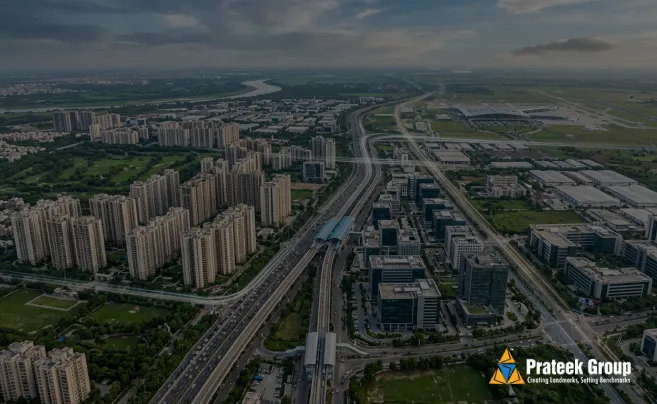
The year 2030 is not some distant milestone on a developer’s brochure. For anyone buying a home or making a property investment in Noida today, it is the most relevant planning horizon available. Four years away, 2030 represents the point by which major infrastructure projects will have either delivered or disappointed, demand cycles will have matured or corrected, and the decisions made today will show their true returns.
Noida has spent the better part of two decades building itself into one of North India’s most credible real estate destinations. That transformation was slow but deliberate. Now the pace has shifted. The Noida International Airport at Jewar became operationally active in June 2026. The Noida Master Plan 2031 has outlined an ambitious framework for land use, connectivity, and employment zones. Commercial absorption figures are climbing. Residential launches in the premium segment have surged. And almost every research firm and analyst following the NCR market is making some version of a bullish prediction about where prices and demand are headed.
But are all these forecasts saying the same thing? Not quite. The range of predictions, the methodologies behind them, and the assumptions they rely on differ considerably. Some analysts are projecting steady 5 to 7 per cent annual price growth. Others are pointing to specific corridors where 30 to 40 per cent appreciation is anticipated over the next three to four years. There are also more cautious voices that flag oversupply risks, affordability ceilings, and the danger of reading too much into short-term data.
At Prateek Group, we have spent over two decades building communities across NCR. We understand that informed buyers are better buyers. So rather than presenting a single-version narrative about Noida’s future, this blog lays out what different analysts are actually forecasting, explains why their numbers vary, and helps you read those forecasts with the clarity they deserve.
If you want to explore our current residential projects across Noida and NCR, that context will help you see exactly where our developments sit within the broader market story being discussed here.
Where Noida Stands Today: The Verified Market Data
Price Appreciation Over the Last Five Years
Before examining future forecasts, it helps to anchor the conversation in what has already happened. The data is striking. According to Anarock Research, average residential prices in Noida saw approximately 92 per cent growth between Q1 2020 and Q1 2025, rising from around Rs 4,795 per sq ft to roughly Rs 9,200 per sq ft. Greater Noida recorded even sharper appreciation, at nearly 98 per cent over the same period, significantly outperforming the broader NCR average.
Colliers data shows Noida absorbed 0.5 million sq ft of Grade A office space in Q3 2025 alone, with rents reaching Rs 65 per sq ft per month on the Expressway corridor. These are not speculative numbers. They reflect active transactions in a market that has moved from being a value-driven alternative to Delhi into a self-sustaining real estate destination.
The Premium Shift in Residential Demand
The composition of demand has changed significantly. JLL India’s Residential Dynamics Report for Q1 2026 noted that residential sales across India’s top seven cities rose 8 per cent year on year to 70,631 units. More telling is the shift within that growth: properties priced above Rs 1 crore now account for 71 per cent of total sales, up from 59 per cent a year earlier. In Delhi NCR specifically, Q1 2026 saw new residential launches jump 64 per cent year on year.
This premium shift is not a Noida-specific phenomenon, but Noida is arguably its strongest expression in the NCR belt. For context, see JLL India’s latest residential market dynamics which tracks quarterly trends across India’s top urban markets. Independently, Knight Frank India’s residential research confirms Delhi NCR among the top-performing markets on price growth, with 12 per cent-plus year-on-year appreciation in Q1 2026.
The Noida Master Plan 2031, administered by the Noida Authority, records 190 educational institutions, 22 hospitals, and over 813 hectares developed for institutional and community facilities. That planned social infrastructure is one of the reasons premium residential demand continues to hold. Buyers at the upper end of the market are not just paying for a home; they are paying for a planned urban ecosystem.
What Different Analysts Are Actually Forecasting: A Comparative View
The real picture emerges when you line up different research perspectives side by side. Analysts are not unanimous. Their forecasts differ in scope, methodology, and the specific variables they choose to emphasise. Here is a structured comparison of the key positions currently circulating in the market.
| Analyst / Source | Forecast Type | Key Prediction | Primary Drivers Cited |
| Industry reports (general consensus) | Price growth rate | 5 to 7% annual appreciation in key Noida micro-markets through 2027-28 | Noida-Greater Noida Expressway, Yamuna Expressway corridors |
| Anarock Research | 5-year cumulative price | 92% price appreciation in Noida from Q1 2020 to Q1 2025; continued growth expected | Jewar Airport, shifting buyer preference to premium |
| JLL India | Segment-level demand | Premium segment (Rs 1 crore+) to dominate NCR sales through 2026-28 | Rising HNI population, GCC expansion, lifestyle preference shift |
| Knight Frank India | Multi-city residential | Delhi NCR among top performers at 12%+ YoY price growth in Q1 2026 | Limited prime land, robust end-user demand, airport-linked investment thesis |
| YEIDA / Government planning | Long-term land use forecast | Aerotropolis model around Jewar; major employment zones by 2030-41 | Jewar Airport, Film City, Medical Device Park, industrial corridors |
| Cautious / Sell-side analysts | Risk assessment | Oversupply risk in certain segments; affordability ceiling for mid-income buyers | Rising base prices, slowdown in home loan growth, income-price mismatch |
A few important clarifications about this table. First, these forecasts are measuring different things. Anarock’s 92 per cent figure is a historical observation, not a projection of what the next five years will deliver at the same rate. JLL’s segment-level predictions refer to the composition of demand, not the absolute price. Government planning documents like the YEIDA Master Plan 2041 describe intended land use and economic development rather than price targets. Comparing these numbers directly without understanding what they measure leads to confusion.
Second, the cautious voices in the market deserve attention. Home loan growth has been moderating. CRIF High Mark data shows housing loan originations grew 9.9 per cent in 2023-24 and just 2.7 per cent in 2024-25, a meaningful deceleration. This does not indicate a collapse, but it does suggest that affordability is not unlimited and that the pace of premium-led appreciation may moderate as base prices rise.
The Infrastructure Pipeline: What Could Reshape the Market by 2030

Jewar Airport: Now Operational, But the Full Impact Is Still Building
Noida International Airport commenced commercial passenger operations in June 2026. Phase 1 is designed for 12 million passengers per annum, with expansion phases that could eventually take total capacity far higher. The airport is not a future catalyst; it is a present reality. However, analysts differ on the timeline of its full economic impact on real estate.
Transaction data already reflects the shift. Yamuna Expressway plot values surged 536 per cent between 2020 and 2025, according to a September 2025 Economic Times report. Land prices near Jewar have nearly doubled in three years, with prices in the airport belt reaching Rs 5 to 6 crore per acre. But analysts who study post-airport property cycles in other cities caution that the sharpest appreciation often occurs in the two years before operational launch. The question for buyers entering now is whether the early-mover window has already closed or whether it remains partially open.
The government’s vision for the corridor is laid out in the YEIDA Master Plan 2041, which outlines an aerotropolis model with industrial zones, knowledge parks, and integrated residential development designed to generate significant employment by 2030 and beyond.
Metro Expansion, FNG, and Road Connectivity
The Noida Expressway, Yamuna Expressway, DND Flyway, and Eastern Peripheral Expressway have collectively reduced commute friction across the NCR belt. The Aqua Line extension towards Boraki and the proposed RRTS link to Jewar Airport are expected to further improve connectivity. The Faridabad-Noida-Ghaziabad (FNG) Expressway, when complete, will open yet another fast corridor between key employment nodes.
For micro-markets like Sector 150 on the Noida Expressway, the connectivity profile is already strong. The sector is accessible via the Noida-Greater Noida Expressway, DND Flyway, and Yamuna Expressway, and sits approximately 15 minutes from Jewar Airport. It also benefits from proximity to the Sector 148 metro station. These factors are frequently cited in analyst notes as reasons why Sector 150 and surrounding corridors remain among the more resilient price zones in the NCR.
Our own project in this corridor, Prateek Canary, reflects precisely this positioning. It offers RERA-approved luxury 3 and 4 BHK residences and duplex penthouses across 664 units on 12.55 acres in Sector 150, Noida (RERA No. UPRERAPRJ591510). The project sits within a sector that the Noida Master Plan 2031 categorises as a low-density, green-belt-dominated zone, which has historically helped preserve both the character and the pricing of the area.
Commercial Growth and Its Residential Spillover
Commercial real estate activity is a reliable lead indicator for residential demand. Established IT hubs in Sectors 62, 125, 135, and along the Expressway continue to attract technology companies and Global Capability Centres (GCCs). The presence of corporate names like Infosys, Microsoft, and Samsung has contributed to an estimated 40 per cent growth in commercial real estate activity over the 2019 to 2024 period, according to market analysis.
Film City, the Medical Device Park, and the Multimodal Logistics Hub near the airport are expected to add significant employment capacity. The Noida Master Plan 2031 specifically identifies IT/ITES expansion in established hubs and SEZ development near Jewar as long-term employment generators. Employment is the one variable that almost all analysts agree will be a sustained driver of residential demand through 2030.
Why Forecast Numbers Differ: The Methodology Gap
When two credible sources publish different numbers for the same market, the difference rarely comes from one being right and the other wrong. More often, it comes from measuring different things across different geographies, time frames, and property types.
Here are the most common reasons Noida forecasts diverge:
- Geography: A forecast for ‘Noida’ may include only central Noida sectors, or it may encompass the Noida-Greater Noida Expressway, Greater Noida West, Yamuna Expressway, and even parts of Ghaziabad. These sub-markets behave very differently. Yamuna Expressway has seen much sharper appreciation than, say, older residential sectors in central Noida.
- Property type: Price appreciation in plotted developments along the airport corridor looks nothing like the appreciation in high-rise apartments in Sector 150. Aggregating these into a single ‘Noida’ figure obscures more than it reveals.
- Segment focus: A luxury-segment analyst tracking properties above Rs 3 crore will see a different market story than a mid-income housing researcher tracking sub-Rs 1 crore inventory. Both can cite real data but arrive at very different conclusions.
- Time horizon: Short-term forecasts (12 to 24 months) are driven by current supply-demand imbalances and interest rate environments. Long-term forecasts (through 2030 or 2041) are driven by structural factors like infrastructure completion, employment growth, and demographic trends. They are essentially different conversations.
- Assumption about airport impact: Analysts differ significantly on how much of the Jewar Airport effect has already been priced in versus how much remains to be realised as the airport scales its operations. This single assumption creates large divergences in corridor-specific projections.
Reading any forecast without understanding its geographic scope, property segment, and time horizon is likely to lead to a misapplied conclusion. A number cited for the Yamuna Expressway corridor cannot simply be applied to a high-rise in central Noida, and vice versa.
The Demand and Supply Balance: Risks That Analysts Are Watching
The Oversupply Question
Not every forecast is uniformly optimistic. Several market observers have flagged the risk of oversupply in specific segments, particularly affordable and mid-income housing. JLL’s Q1 2026 data noted that new residential launches across India’s top seven cities rose 13 per cent year on year to 90,023 units, while Delhi NCR recorded a 64 per cent surge in new launches for that quarter alone. High launch volumes, if not matched by absorption, can create inventory overhang.
The flip side is that supply is increasingly concentrated at the premium end. The sub-Rs 1 crore segment saw a 24 per cent year-on-year contraction in sales in Q1 2026. Affordable housing absorption is slowing as base prices have risen beyond what first-time buyers in mid-income brackets can comfortably reach. This structural mismatch is something buyers should factor into their own positioning, not as a reason to avoid the market, but as a reason to understand which segment they are entering.
Rental Market Signals
Rental data offers a useful real-time read on occupant demand. Greater Noida recorded 5.4 per cent quarter-on-quarter rent growth in the December 2025 quarter, according to Magicbricks data. This is meaningful because rental demand responds directly to employment concentration and urban migration patterns, rather than to speculative capital flows. Sustained rental growth in a market is generally a more reliable demand signal than short-term price appreciation.
Residential rental yields in Noida and Greater Noida currently sit in the 3 to 5 per cent range, while commercial properties are yielding 6 to 7 per cent. These yields are below what many investors might target in isolation, but in a market where capital appreciation has been compounding at significantly higher rates, the total return picture looks considerably more attractive.
What the Cautious Analysts Are Right About
There are legitimate questions about the sustainability of current appreciation rates. A market that delivered 92 per cent cumulative appreciation in five years is statistically unlikely to repeat that same rate in the next five years without a proportional increase in incomes and employment. The pace will almost certainly moderate. Analysts who are projecting a more measured 5 to 8 per cent annual growth for stabilised Noida corridors through 2030 are working from a more historically grounded assumption than those extrapolating the 2020-2025 trajectory forward.
For buyers, the practical implication is straightforward: do not base your investment decision on peak-cycle appreciation figures. Evaluate the fundamentals, namely employment growth, infrastructure delivery, developer credibility, and product quality, and then form a view on what a realistic outcome looks like.
What These Forecasts Mean for Homebuyers and Investors in Practice

Checklist for Buyers Evaluating the 2030 Outlook
If you are using these forecasts to inform a purchase decision, here is a practical framework for applying them sensibly:
- Verify the RERA registration of any project under consideration at the UPRERA portal (up-rera.in) before committing. Any Noida residential project above 500 sq metres or 8 units must be registered.
- Identify which micro-market the forecast applies to. A projection for the Yamuna Expressway corridor does not apply to Sector 150, and a central Noida forecast does not describe conditions on the Ghaziabad border.
- Assess employment proximity. Properties that sit within practical commuting distance of established IT hubs in Sectors 62, 125, and 135, or of the upcoming airport corridor employment zones, carry structurally stronger rental and resale demand.
- Evaluate developer track record. In a market where supply has expanded sharply, delivery quality and possession timelines vary significantly between developers. Past delivery data is a more reliable predictor than marketing materials.
- Separate capital appreciation from rental yield expectations. If you are an investor, understand which return metric you are primarily targeting and evaluate the asset accordingly.
- Do not treat any forecast as a guarantee. Infrastructure projects face delays. Employment cycles fluctuate. Interest rates shift. Every projection in this blog, including those from JLL, Anarock, Knight Frank, and others, is a considered estimate, not a committed outcome.
How We Position Our Projects Within This Context
At Prateek Group, we are not in the business of making market promises we cannot keep. We build in locations where the fundamentals are structurally sound, and we let the market dynamics speak for themselves. Our residential portfolio across Noida and the NCR is designed to serve buyers who are making considered, long-term decisions.
Prateek Canary in Sector 150, Noida, sits in one of the most well-documented premium growth corridors in the NCR. It is connected to three expressways, adjacent to a 9-hole golf course, and positioned in a sector where the Noida Master Plan 2031 has designated maximum area for green cover and low-density development. These are characteristics that multiple analyst reports consistently cite as premium-segment price support factors.
In the Ghaziabad corridor, Prateek Grand Begonia at Prateek Grand City, Siddharth Vihar (NH-24), offers 2 and 3 BHK luxury apartments within a 40-acre integrated township (RERA No. UPRERAPRJ790651). Siddharth Vihar’s position along NH-24, next to Indirapuram, has made it one of the more active mid-to-premium markets in the broader NCR belt, with strong rental demand from working professionals and good expressway connectivity.
For NRI buyers tracking the India market from abroad, the combination of airport-linked growth, RERA transparency, and rupee-denominated assets in a fast-urbanising corridor makes Noida and adjacent NCR locations a credible consideration within a diversified property strategy.
Our dedicated page on real estate investment in India for NRIs covers regulatory guidelines, RBI rules, and practical FAQs for overseas Indian buyers.
Conclusion: How to Read These Forecasts Realistically
The headline story about Noida’s real estate market heading toward 2030 is broadly positive, and the data supports that. A city with an operational international airport, a well-planned master framework, expanding commercial employment, improving metro connectivity, and a demonstrated track record of absorbing premium residential supply is structurally better positioned than most alternatives in the NCR.
But the nuance matters. Different analysts are measuring different things. The 92 per cent appreciation recorded between 2020 and 2025 reflects a specific cycle driven by post-pandemic demand recovery, interest rate conditions, and infrastructure anticipation. The years ahead will be driven by delivery, not anticipation. The airport is open. Film City is planned. The question is how quickly these catalysts translate into jobs, which translate into migration, which translate into sustained housing demand.
The most reliable way to read any market forecast is to ask three questions: What specifically is being measured? Over what geography and time horizon? And what are the key assumptions the analyst is making about factors that have not yet materialised?
For buyers looking at Noida real estate today, the 2030 horizon offers a reasonable planning window. Entry price matters, segment matters, location specificity matters, and developer quality matters. A broad forecast about ‘Noida’ doing well does not automatically validate a specific purchase decision. The forecast is context; the decision requires a deeper look at the asset itself.
We have been building homes and communities in this region for over two decades. If you want to understand how specific projects within our portfolio align with the forecast landscape discussed here, we are happy to walk you through the detail.
FAQs
- What is the future of Noida real estate by 2030?
Noida real estate is expected to remain a strong growth market through 2030 due to infrastructure expansion, Jewar Airport, commercial development, employment growth, and planned urban development. However, appreciation will vary depending on location, segment, and project quality.
- Will Noida property prices increase by 2030?
Noida property prices are expected to grow steadily toward 2030, supported by infrastructure and demand drivers. Analysts generally expect moderate annual appreciation rather than the exceptional growth rates seen between 2020 and 2025.
- Is Noida a good investment for the next 5 years?
Noida can be a suitable investment option for buyers with a medium to long-term horizon. Factors like Jewar Airport, commercial expansion, employment growth, and improving connectivity support the market, but location and developer selection remain critical.
- What will be the impact of Jewar Airport on Noida property prices?
Jewar Airport is expected to strengthen Noida’s real estate market by attracting businesses, improving connectivity, and creating employment opportunities. However, the full property impact will develop gradually as commercial activity and job creation increase around the corridor.
- Which Noida areas will perform best by 2030?
Locations with strong infrastructure, employment access, and planned development are expected to perform better. Areas like Sector 150, Noida Expressway, and selected Yamuna Expressway corridors are likely to benefit from connectivity and long-term urban growth.
- What are analysts predicting for Noida real estate in 2030?
Different analysts have varying forecasts based on geography, property type, and market assumptions. Most agree that Noida has strong fundamentals, with growth supported by infrastructure, premium housing demand, commercial expansion, and employment generation.
- Will Noida real estate become expensive by 2030?
Noida property prices may become more expensive as infrastructure improves and demand increases. However, future affordability will depend on income growth, interest rates, housing supply, and the balance between premium and mid-income residential segments.
- Is buying property in Noida before 2030 a good decision?
Buying property before 2030 may benefit long-term buyers who choose locations with strong fundamentals. Investors should focus on verified infrastructure, developer reputation, RERA compliance, and realistic appreciation expectations instead of relying only on market predictions.
- How reliable are Noida property price predictions for 2030?
Property forecasts provide market direction but cannot guarantee future prices. Predictions depend on assumptions about infrastructure completion, economic conditions, interest rates, employment growth, and demand patterns that may change over time.
- What factors will drive Noida real estate growth until 2030?
Major growth drivers include Jewar Airport, Noida Master Plan 2031, commercial development, IT and GCC expansion, metro connectivity, expressways, employment generation, and increasing demand for premium residential communities.
- Are there risks in investing in Noida real estate before 2030?
Risks include oversupply in certain segments, rising property prices affecting affordability, infrastructure delays, and choosing projects without strong delivery records. Buyers should evaluate individual projects rather than relying only on overall market growth forecasts.
- Is Sector 150 Noida a good investment for 2030?
Sector 150 has strong long-term appeal due to low-density planning, green surroundings, expressway connectivity, metro access, and premium residential development. Its growth potential is supported by multiple infrastructure advantages rather than a single future catalyst.
- How will employment growth affect Noida property demand?
Employment growth will play a major role in sustaining Noida’s residential demand. Expansion of IT hubs, GCCs, manufacturing, logistics, and airport-linked industries can attract professionals who create both rental and ownership housing demand.
- Should I invest in Noida for rental income or capital appreciation?
Noida is generally viewed as a capital appreciation-focused market rather than a high rental-yield destination. Investors should evaluate both rental potential and long-term price growth based on location, employment access, and property quality.
- What should buyers check before investing in Noida real estate for 2030?
Buyers should verify RERA registration, developer track record, location fundamentals, infrastructure timelines, employment connectivity, pricing comparisons, and project quality. A long-term investment decision should be based on asset-level research rather than broad market forecasts.






Leave a Reply