

For most of the last decade, buyers evaluated Sector 150 on promises. A greener sector was promised. An airport was promised. Metro connectivity was promised. Buyers paid a premium for a future that had not arrived yet. In 2026, a large part of that future has arrived, and the way you evaluate an upcoming project here needs to change with it.
Noida International Airport at Jewar was inaugurated on 28 March 2026 and began commercial flights in mid-June. The Union Cabinet cleared the Aqua Line extension between Sector 142 and Botanical Garden in February 2026. And after five years of uncertainty, the registry freeze that had paralyzed thousands of Sports City flats in Sector 150 began to lift from January 2026 under a Supreme Court-supervised framework.
We are Prateek Group, and we have been building in Noida and the wider NCR for over two decades. One of our own projects, Prateek Canary Sector 150 Noida, sits inside this micro market, so we will say upfront that we are not a neutral party. What we can offer instead is transparency about how the sector actually works, what the numbers say, and where our own project has limitations alongside its strengths.
This blog is built for someone who is shortlisting. It covers why Sector 150 commands the price it does, which projects are genuinely upcoming versus which are simply marketed that way, how they compare, which buyer each one suits, and the checks that separate a sound booking from an expensive mistake. Where a project has a genuine weakness, including ours, we have said so.
TL;DR
Why Sector 150 Is Redefining Premium Living
Sector 150 has evolved from a future-focused investment destination into one of Noida’s most established premium residential markets. This guide explains why buyers continue choosing the sector in 2026, what has changed with major infrastructure milestones, and how upcoming residential projects compare across pricing, density, connectivity, and long-term value.
Not Every “Upcoming” Project Is Worth Shortlisting
Many projects marketed as upcoming differ significantly in regulatory approvals, construction progress, possession timelines, and developer credibility. This guide highlights the common risks buyers overlook, including RERA compliance, registry status, authority dues, project density, and hidden ownership costs that can directly impact future returns.
Choose the Right Project, Not Just the Right Location
The strongest investment outcomes come from selecting projects with proven developers, transparent documentation, realistic delivery timelines, and low-density planning rather than relying on marketing claims. By following a structured evaluation framework, buyers can confidently shortlist properties that match their budget, lifestyle, and long-term investment goals.
Why Sector 150 Is Attracting Buyers in 2026
Before comparing projects, it helps to understand what the sector itself is selling. Sector 150 is not premium because of any single building. It is premium because of a planning decision taken years before most of these towers came up.
The planning decision that created the premium
Sector 150 was master-planned across roughly 600 acres with an unusually high share of land reserved for open space, greens and sports use rather than saleable floor area. Around 80 percent of the sector’s footprint is dedicated to green and open areas, including one of India’s larger urban parks laid out across about 40 acres, sports facilities spread over more than 100 acres, and a nine-hole golf course within the sector.
Why does that matter? Because open space is the one amenity a developer cannot retrofit. A clubhouse can be upgraded. A lobby can be renovated. Sky is fixed at master planning. In most NCR sectors, density rose as land values rose. Here, the low-density character was locked into the sector layout itself, which is why Sector 150 still feels different when you drive through it.
The price evidence
According to ANAROCK’s Q1 2026 Residential Market Viewpoints, Sector 150 recorded an average quoted base price of around Rs 14,600 per square foot against an NCR average closer to Rs 9,620 per square foot in the same quarter. That is a gap of roughly 50 percent over the regional average.
Listing platform data over a longer horizon agrees on direction. Flat rates here have moved up well over 100 percent across five years, with a six-year compound annual growth rate near 13 percent. Absolute numbers vary by portal, generally in the Rs 12,000 to Rs 16,500 band depending on project and tower.
Two honest caveats. Past appreciation is a poor predictor of future appreciation. And much of the sector’s historic gain came from a low base, when Sector 150 was an outlying address. The easy money here was made between 2018 and 2024. What buyers are underwriting in 2026 is the next phase, not the last one.
The airport is no longer a projection
The single biggest change to the Sector 150 investment case is that the infrastructure story stopped being forward-looking.
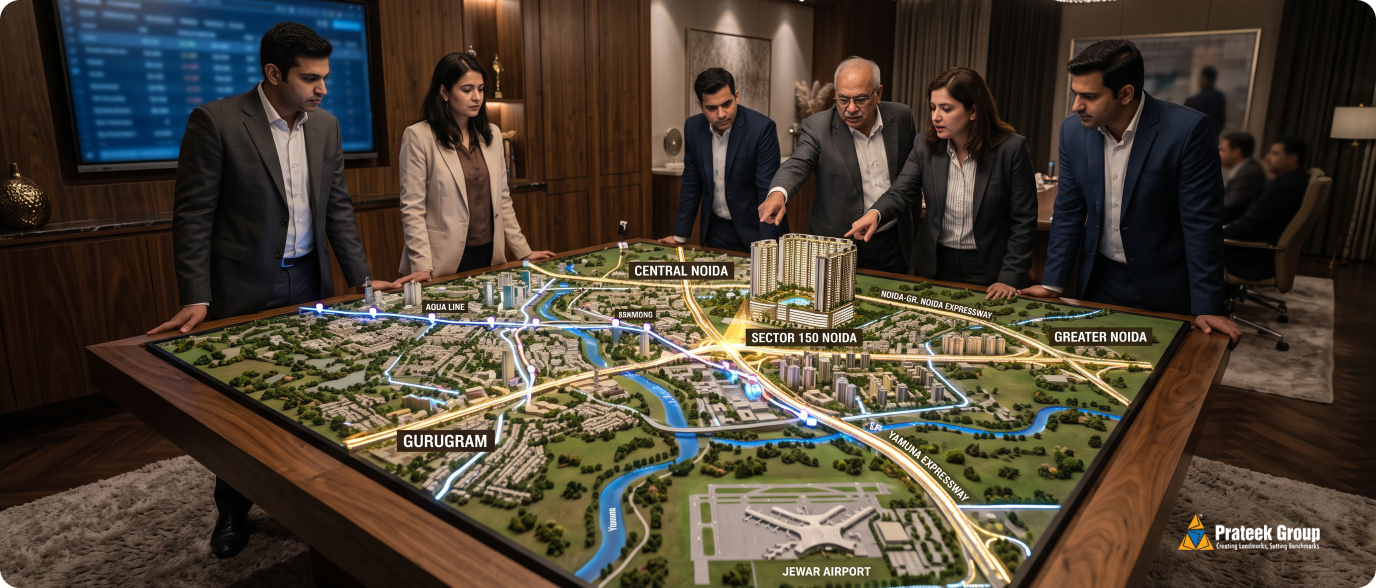
Phase 1 of Noida International Airport was inaugurated on 28 March 2026, developed at a cost of roughly Rs 11,200 crore, with a first phase capacity of about 12 million passengers a year. Commercial flights began in mid-June 2026, with IndiGo as the first carrier and Akasa Air following within days. Sector 150 sits roughly 30 to 40 kilometers away via the Yamuna Expressway, which places it within a comfortable drive of a working international gateway rather than a construction site.
We would temper the enthusiasm slightly. Early traffic has been modest, with reported passenger counts for the first two months totalling a little over 61,000, a fraction of what the terminal is built to handle. Route expansion and international services will matter far more to property values than the launch itself did. For the longer view, see our note on how Jewar Airport will change property prices in Noida and Greater Noida.
The point for a buyer in 2026: airport risk has largely been removed. Airport ramp-up risk has not.
Metro connectivity is now funded, not just discussed
In February 2026, the Union Cabinet approved the extension corridor from Noida Sector 142 to Botanical Garden, an 11.56 kilometer elevated stretch with eight stations at an estimated Rs 2,254 crore, targeted for completion in about four years. On commissioning, the combined Noida and Greater Noida network moves past 61 kilometers.
For Sector 150 the benefit is indirect but real. The Aqua Line already serves the sector through the Sector 148 station, roughly four to five kilometers from most projects. Today a commuter heading into Delhi must exit at Sector 52 and walk across to Sector 51 to change lines. Once the extension is live, the Botanical Garden becomes a direct interchange with the Blue and Magenta lines, converting a two-seat journey into a genuine single-system commute.
The registry unlock
Registrations across the Sector 150 Sports City land had been frozen since January 2021, tied to unpaid developer dues to the Noida Authority and incomplete sports infrastructure commitments. Thousands of families had possession without registry, meaning no clean title, constrained resale and complications on loans.
In November 2025 a Supreme Court bench accepted the Noida Authority’s resolution plan permitting conditional occupancy certificates and registries for compliant developers. Registrations began reopening from 7 January 2026, and the Authority’s board formalized the framework in April 2026.
The mechanics matter. Developers must deposit 20 percent of outstanding dues within 60 days, with the balance payable in six half-yearly installments across three years. A zero-period relief waives interest and penalties for the COVID phase and the freeze years. Registries can now proceed tower by tower rather than waiting for full project completion. In return, developers remain bound to deliver sports infrastructure under the sector’s 70:30 land use rule. Around 9,000 flats were covered by the initial opening, and registry-ready inventory has been commanding a visible premium since.
The caveat: approval is conditional and granted project by project. If a developer misses payment or construction milestones, the Authority can pause occupancy certificates and registries again. This is why the most useful question you can ask about any Sector 150 project is not about amenities. It is about where that specific developer stands on authority dues.
What “Upcoming” Actually Means in Sector 150 Right Now
Search results will show you dozens of upcoming listings. Most are misleading.
Sector 150 is close to fully allotted, and the Noida Authority is not releasing large fresh residential parcels here. Almost nothing in the sector is genuinely a new launch on virgin land. What buyers are actually choosing between falls into four categories.
- Under construction inventory in registered projects. Towers at an advanced stage with a RERA-declared completion date. Most credible Sector 150 supply sits here in 2026.
- New phases of existing developments. Where a developer holds an adjacent parcel or a second phase within the same registration.
- Recent launches on remaining parcels. A small number of genuinely recent registrations, typically premium and typically small.
- Speculative listings. Marketed as upcoming with no RERA registration, no approved layout and no confirmed timeline. These are not comparable to the categories above.
The supply squeeze shows in the wider data. ANAROCK reported NCR new housing launches falling about 40 percent year-on-year in Q2 2026 to 11,205 units, while sales held far better at 13,365 units, down only 6 percent. Within that, Noida and Greater Noida saw the sharpest correction, with new launches down roughly 72 percent to 2,140 units. Available NCR inventory stood at 89,086 units at quarter end, essentially flat year on year, meaning the region sold more than it launched.
What this means for you. Choice in Sector 150 is narrowing, not widening. Waiting for a better launch is a weaker strategy here than in a sector with active land supply. Equally, a thin pipeline is exactly the environment where poorly documented projects get marketed hardest. Verify registration before you shortlist, not after.
How We Evaluate an Upcoming Project: A Seven Filter Framework

Here is the framework we would apply if we were buying rather than building. The order matters, because early filters eliminate more risk than later ones.
- Regulatory standing. Is the project registered with UP RERA, and what does the registration say about the completion date, unit count and land area? Is the developer current on Noida Authority dues? In Sector 150 this carries more weight than anywhere else in Noida.
- Delivery record. Not marketing history, but delivery history. How many projects has this developer completed with occupancy certificates obtained?
- Density, not land size. A 25-acre project with 2,000 units is denser than a 12-acre project with 660. Units per acre determine how a community feels. Ask explicitly, because brochures rarely volunteer it.
- Configuration fit. A 1,700-square-foot 3 BHK and a 2,400-square-foot 3 BHK are different products. Compare on carpet area, not on BHK count.
- Possession realism. Compare the marketed date, the RERA completion date, and the last two quarterly progress reports. Gaps between those three tell you more than any site visit.
- Total cost. Location charges, parking, club membership, power backup, GST, stamp duty and registration add materially to a quoted base rate.
- Exit liquidity. Who buys this unit from you in seven years? A 1,700 square foot 3 BHK in a registry-clear project has a deep buyer pool. A 3,300-square-foot penthouse has a shallow one.
The Shortlist: Upcoming and Under Development Projects in Sector 150
Details below are drawn from public RERA registrations, developer disclosures and listing portals as of July 2026. Numbers reported by different sources do vary, sometimes materially, which is itself a reason to verify directly before booking.
Prateek Canary
Developer: Prateek Group | Land parcel: 12.55 acres, Plot SC-02/A7 | Units: 664 across nine towers | Density: approximately 53 units per acre | Configuration: 3 and 4 BHK plus duplex penthouses | RERA: UPRERAPRJ591510 | Nearest metro: Sector 148, roughly 4.5 km
What the design prioritizes. The defining decision at Canary was to cap the unit count. On 12.55 acres a conventional layout could have accommodated considerably more homes. Holding it at 664 produces roughly 53 units per acre, placing the project among the lower-density developments in the sector rather than merely near the sector average.
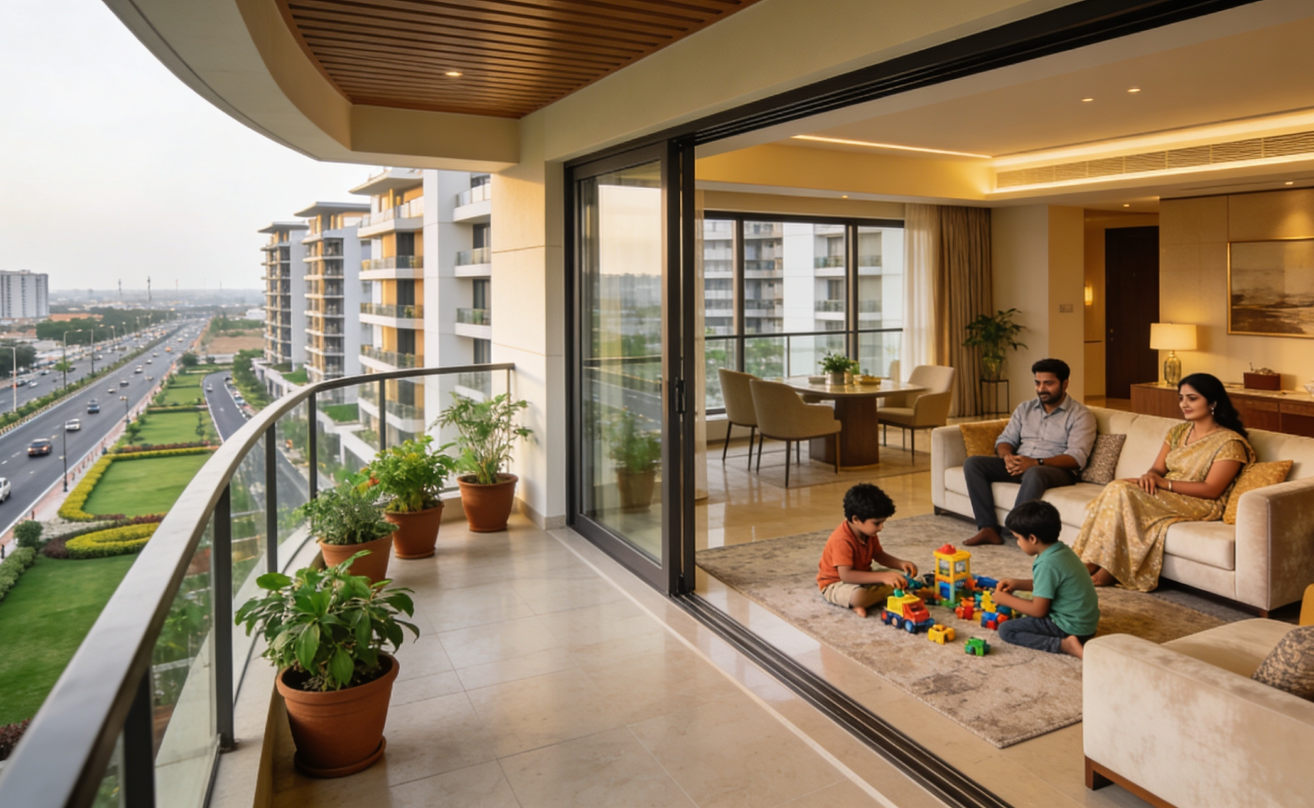
That decision cascades. Towers sit further apart, which protects sightlines. Several carry only two to four homes per floor. Homes have large private party decks rather than standard balconies, and most look out over green cover, with a portion facing the sector’s golf course.
Amenities are organized into zones rather than a single clubhouse block: a sports zone with tennis, half basketball, a net cricket pitch and a skating rink; a forest retreat with dense plantation, a forest trail and a yoga lawn; an open lawn zone with an amphitheater and senior citizen sit-outs; and a clubhouse zone with adult and kids’ pools and a party lawn.
Price. Reported pricing has ranged widely across portals, broadly from around Rs 13,000 per square foot at the lower end of the super area range upward, with larger and penthouse configurations pushing ticket sizes considerably higher. With unit sizes spanning roughly 1,700 to 3,355 square feet, the range here is unusually wide for a single project. Ask for the current price list directly rather than working from portal estimates.
Considerations, stated plainly. Three of them. First, this is not an entry price product, and it is the wrong choice for a buyer stretching to maximum loan eligibility. Second, the RERA registration records a completion date in 2027, and construction is at an advanced stage; check the current tower-wise status and the most recent quarterly progress report rather than relying on any single stated date. Third, Canary sits within the SC-02 Sports City layout, so the registry framework described earlier applies here as it does to neighboring projects. Ask us directly where we stand on authority dues and occupancy certification. We would rather answer that than have you discover it later.
Who it suits. Families buying to live, who value low density and green outlook over proximity to retail, and who intend to hold for seven years or more. It suits NRI buyers for similar reasons. It is a weaker fit for a buyer chasing rental yield, since Sector 150 yields sit in the 2 to 3 percent band across the board.
ATS Pious Orchards
Developer: ATS HomeKraft | Land parcel: approximately 9.31 to 10 acres | Units: 608 across 10 towers | Configuration: 3 and 5 BHK | RERA: UPRERAPRJ183246
This is the project most often positioned as the direct alternative, and the comparison is fair. Density is similar at roughly 60 to 65 units per acre depending on which land figure you use, with open space reported around 80 percent and orientation toward the Yamuna side and an orchard-themed central park.
Considerations. Possession guidance is where to focus. Marketing indicates handover beginning as early as December 2026, while RERA and detailed project tracking point to final completion extending to September 2028. That spread is not unusual in a ten-tower project completing sequentially, but confirm the timeline for your specific tower, not the project. Reported pricing also varies widely across sources, so treat older portal figures with caution.
Who it suits. Buyers who want a very large-format home, particularly the 5 BHK, which is scarce in this sector, and buyers comfortable with a longer possession horizon.
Tata Eureka Park and Phase 2
Developer: Land Kart Builders, a Tata Value Homes and Lotus Greens entity | Configuration: 2 and 3 BHK | Status: Phase 1 complete with occupancy certificate received in 2025; Phase 2 under construction with a RERA possession indication of September 2026
This is the most relevant option for buyers wanting a Sector 150 address at a lower entry ticket. The 2 BHK configuration is uncommon in the sector’s newer premium supply, and the project leans on home automation and a large clubhouse.
Considerations. Density is materially higher than at Canary or Pious Orchards, and that is the trade-off funding the lower price. If low density is why you are looking at Sector 150, this project delivers less of it. Against that, Phase 1 being complete with an occupancy certificate is a meaningful de-risking signal.
Who it suits. First-time buyers in the sector, buyers with a budget ceiling below the premium projects, and investors prioritizing lettability, since smaller configurations rent more easily.
Godrej Palm Retreat, Nurture and Solitaire
Developer: Godrej Properties | Scale: Nurture is roughly 9 acres with about 385 units; Solitaire is a smaller format at around 160 units; Palm Retreat is the largest and most resort-oriented.
Godrej’s presence here spans three distinct products rather than one, letting buyers stay within a single developer relationship at different price points. Palm Retreat is positioned around resort-style landscaping, Nurture around family- and child-oriented programming, and Solitaire as a smaller, more exclusive format.
Considerations. Brand strength is genuine, and the national delivery record is among the stronger ones in Indian residential real estate. The trade-off is a brand premium in pricing, and smaller land parcels mean the green experience depends more on the sector’s surrounding open space than the project’s own footprint.
Who it suits. Buyers who weigh developer brands heavily and those who want a smaller, more contained community.
Eldeco Live By The Greens
Developer: Eldeco | Units: approximately 688
Positioned around greens and sporting facilities, this is one of the sector’s more established premium communities, frequently compared against Tata Eureka Park in the same budget band.
Considerations. This is a comparatively mature project rather than genuinely upcoming stock, so buyers are often looking at resale or late-stage inventory. The advantage is that you can see the finished product. The disadvantage is that early-stage appreciation has already been captured.
County Sector 150
Developer: County Group | Land parcel: approximately 25 acres | Configuration: 2, 3 and 4 BHK | Status: upcoming
This is the largest single parcel among genuinely upcoming projects in the sector, positioned around low-density planning with a stated majority of the site given to landscape.
Considerations. Because it is an early stage, most meaningful verification is not yet possible. There is no construction to inspect and no quarterly progress history to read. Early entry can deliver the best appreciation in a supply-constrained sector, and it carries the highest execution risk. Both are true at once.
Who it suits. Long-horizon buyers with an appetite for early-stage risk, willing to underwrite the developer rather than the building.
Max Antara Noida
Developer: Max Group | Land parcel: approximately 8 acres | Configuration: 2 and 3 BHK senior living residences
Antara is a specialized product. It is a senior living community with care infrastructure built into the operating model, pricing at the top of the sector, with listing data placing it above Rs 17,000 per square foot.
Who it suits. Families buying specifically for ageing parents, or buyers planning their own retirement. It should not be compared on price per square foot against conventional apartments, because it includes services those do not.
ACE Group projects
ACE has a long-standing presence across residential projects such as ACE Parkway and ACE Golfshire, alongside ACE Medley Avenue on the commercial side. The commercial component matters more than buyers usually credit, because retail within the sector reduces dependence on driving out for daily needs, historically one of Sector 150’s genuine weaknesses.
Side-by-Side Comparison
| Project | Developer | Land parcel | Units | Approx. density | Configuration | Status / possession |
| Prateek Canary | Prateek Group | 12.55 acres | 664 | ~53 per acre | 3, 4 BHK + penthouses | Advanced stage; RERA completion 2027 |
| ATS Pious Orchards | ATS HomeKraft | ~9.31 to 10 acres | 608 | ~60 to 65 per acre | 3, 5 BHK | Under construction; Dec 2026 to Sep 2028 |
| Tata Eureka Park Ph. 2 | Tata Value Homes / Lotus Greens | Multiphase | Large format | Higher | 2, 3 BHK | Ph. 1 complete with OC; Ph. 2 c. Sep 2026 |
| Godrej Nurture | Godrej Properties | ~9 acres | ~385 | ~43 per acre | 2, 3 BHK | Under construction |
| Eldeco Live By The Greens | Eldeco | Established | ~688 | Moderate | 2, 3 BHK | Largely delivered / late stage |
| County Sector 150 | County Group | ~25 acres | To be confirmed | To be confirmed | 2, 3, 4 BHK | Upcoming / early stage |
| Max Antara Noida | Max Group | ~8 acres | Phased | Low | 2- and 3-BHK senior living | Operational and phased |
Density figures are derived from publicly reported unit counts and land areas and should be confirmed with each developer. Where sources disagree, we have shown the range rather than the flattering end.
Buyer Suitability Matrix
| Buyer profile | Strongest fit | Why | Watch out for |
| Growing family, end use, long hold | Prateek Canary | Low density, green outlook, large formats | Premium ticket size; not entry price |
| First time buyer in the sector | Tata Eureka Park | Lowest entry point; Phase 1 has OC | Higher density than premium stock |
| Buyer wanting maximum floor area | ATS Pious Orchards | 5 BHK formats are scarce here | Wide gap between marketed and RERA dates |
| Brand led buyer | Godrej projects | Strong delivery record; three formats | Brand premium; smaller internal parcels |
| Early stage investor | County Sector 150 | Largest upcoming parcel; earliest pricing | Nothing to physically verify yet |
| Buying for ageing parents | Max Antara Noida | Purpose built senior living with care model | Highest rate; specialised resale market |
| Rental yield focused investor | Reconsider the sector | Yields sit at roughly 2 to 3 percent | Capital growth market, not cash flow |
That last row deserves emphasis, because it is where we see the most disappointed buyers. Sector 150 is a capital appreciation micro market. If your model depends on rental income covering a substantial share of your EMI, the arithmetic will not work here at current price levels, and no project changes that.
Investment Comparison: Three Realistic Scenarios
Rather than quoting a single appreciation forecast, which no one can honestly provide, think in scenarios. Assume a purchase in a registry-clear, RERA-compliant project at prevailing rates, held for seven years.
Scenario A: Infrastructure delivers on schedule. Metro commissions its four-year target, the airport scales toward phase one capacity with international routes added, and Sports City obligations are complete. Sector 150 widens its premium over the corridor and appreciation tracks above the NCR average.
Scenario B: Infrastructure delivers late. Metro slips a couple of years, airport ramp-up is slower than projected, and sports infrastructure is completed partially. Appreciation moderates toward the NCR average. Buyers who paid a heavy premium for early-stage inventory see the thinnest returns; buyers in completed, registry-clear stock hold up better.
Scenario C: A project-specific setback. The sector performs adequately, but a developer misses authority payment milestones, and registries pause again for that project. This hurts most, and it is almost entirely avoidable through Filter 1.
Outcomes are not symmetric. Sector-level risk is now reasonably contained. Project-level risk is not. Choose the developer more carefully than the sector.
A note on financing. The Reserve Bank of India has held the repo rate at 5.25 percent through 2026 following its December 2025 cut, with home loan rates broadly in the 8.5 to 9.5 percent band. Rates are near the softer end of the recent cycle, which improves affordability relative to 2023 and 2024, but a floating-rate loan remains a floating-rate loan. Model your EMI at a rate one to one and a half percentage points above today’s, and proceed only if that number is comfortable. If you are weighing timing more broadly, our analysis of ready-to-move vs under-construction flats in Noida works through the trade-offs.
Lifestyle Comparison: What Daily Life Actually Looks Like
Green and open space. The genuine differentiator is felt rather than measured. The 80 percent open space share, the 40-acre park and the golf course produce something rare in the NCR: sightlines. Low-density projects deliver it best, because their layouts reinforce the sector’s rather than fighting it.
Daily convenience. The genuine weakness, and we would rather state it than let you find it in month two. Sector 150 has been light on neighborhood retail, quick groceries, clinics and casual dining relative to established Noida sectors. It is improving, but a buyer moving from Sector 62 or Indirapuram should expect to drive more for small errands.
Schools and healthcare. Reputable options are accessible along the corridor and neighboring sectors, but they are a drive rather than a walk. Factor school commute into tower and unit selection, because fifteen minutes compounds twice a day for a decade.
Commute. For anyone working in Sector 62, Sector 16, or Delhi, this is a long commute, and no framing changes that. For anyone working in Sectors 125 to 145, at Gautam Buddha University or in Greater Noida, it is comfortable. Be honest about which you are.
Air and noise. Distance from arterial congestion produces a measurably quieter environment than central Noida. It is not immune to NCR’s seasonal air quality problems, and no one should suggest otherwise.
If you are weighing Sector 150 against other Noida options on cost, our comparison of Greater Noida West vs Sector 150 sets out the budget math side by side.
What Buyers Should Verify Before Booking
Every item here is verifiable before you pay a token amount.
- RERA registration and current status. Look the project up on the UP RERA portal using its registration number. Check the declared completion date, registered land area and unit count against what the sales presentation told you. Discrepancies are informative.
- The last two quarterly progress reports. UP RERA requires building-wise and floor-wise completion percentages plus current photographs. The window for the quarter ending March 2026 ran from 1 to 15 April, and the regulator has been penalizing defaulters. A developer who has not filed is telling you something.
- Authority dues and occupancy certificate status. Ask in writing whether the developer has cleared the required 20 percent of outstanding dues and whether your tower has conditional or full occupancy certification. This is the highest impact question in this sector.
- The escrow arrangement. Under UP RERA’s revised project account rules effective May 2026, developers must operate a three-account structure, with at least 70 percent of buyer collections transferring daily into a separate account restricted to land and construction costs and withdrawals certified by an architect, engineer and chartered accountant. Pay into that account only.
- The full cost sheet. Base rate, location charges, parking, club membership, power backup, infrastructure charges, GST, stamp duty and registration. Two projects quoting similar rates can differ by several lakh once everything is added.
- Carpet area, not super area. Loading varies materially between projects, and that is where apparent bargains disappear.
- The builder-buyer agreement, in full. Read the delay compensation, escalation, specification change and cancellation clauses. Every clause is enforceable. Do not sign under pressure from a limited-period offer.
- Assured return offers. UP RERA has restricted developers from using allottee funds to pay assured return schemes. Treat any such offer as a reason for scrutiny rather than a benefit.
Our detailed homebuyer checklist for 2026 expands each of these into a document-by-document walkthrough.
Common Mistakes Buyers Make in Sector 150
Comparing marketed possession dates instead of RERA dates. Marketing quotes the earliest possible tower. RERA records the last. The gap can be two years.
Treating the registry reopening as fully resolved. It is conditional and project-specific. Verify the status of your project, not the sector.
Buying floor area instead of usable space. A 2,400-square-foot apartment with heavy loading and an awkward layout can deliver less usable space than an efficient 2,000-square-foot unit. Walk a sample flat.
Underestimating holding costs during construction. Between EMI on disbursed tranches and rent on your current home, the pre-possession period carries real cash flow cost. Model it for the full period, not the optimistic one.
Ignoring the tower and the floor. Within the same project, a unit facing green space and one facing a service road differ meaningfully in both liveability and resale. This costs nothing to get right and is expensive to get wrong.
Buying the amenity list. Every premium project here has a pool, a gym and a clubhouse. Amenities are the least differentiated variable in Sector 150 and absorb a disproportionate share of buyer attention. Density, developer standing and possession certainty differentiate far more.
Myths and Reality
Myth: Sector 150 is too far from everything. It is far from central Noida and Delhi and close to the expressway employment hubs, the Yamuna Expressway and the airport. Whether it is far depends entirely on where you work.
Myth: The registry problem means the sector should be avoided. The problem was real and has moved into structured resolution under Supreme Court supervision, with registrations reopening from January 2026. The correct response is project-level verification, not sector-level avoidance.
Myth: All Sector 150 projects are low density because the sector is. The sector’s open space share is a planning characteristic. Individual project density varies from roughly 43 units per acre at the lower end to well above 65 at the higher end. Ask for the number.
Myth: The airport will double property prices. Airports raise regional values over long horizons, and most anticipatory gain in this corridor was priced in between 2018 and 2025. Passenger traffic in the first two months was just over 61,000. The real unlock comes from sustained route expansion, which takes years.
Myth: Buying early always gives the best return. Early entry pricing is compensation for execution risk, not a free discount. It rewards you when the developer delivers and penalizes you when they do not.
Future Growth Potential: What to Watch Between Now and 2032
Airport ramp up. Watch route count and international operations rather than the fact of the airport existing. The Noida International Airport is designed to scale well beyond phase one, and YEIDA’s published development plan for the Jewar project sets out the long-term build-out across subsequent phases.
Metro commissioning. The Sector 142 to Botanical Garden extension is targeted for roughly four years from its February 2026 approval. Delays are common across Indian metro projects. Treat announced dates as intent and watch tendering and construction milestones as the real signal.
Sports City completion. The 70:30 land use obligation binds developers to deliver sports infrastructure alongside residential towers. Completion would meaningfully differentiate Sector 150 from every competing address on the corridor. Non-completion is the most significant downside risk to the sector’s premium.
Commercial and employment depth. The biggest structural weakness is the thin daily convenience layer. Grade A office absorption along the expressway, retail inside the sector, and schools and healthcare within walking distance would address it. This is the variable most likely to change the lived experience over the next five years.
Supply exhaustion. With the sector close to fully allotted and regional launches down sharply, medium-term supply is constrained. That supports prices when demand holds. It does not create demand on its own.
Our earlier assessment of whether Sector 150 is still the best place to buy in Noida and our note on the hidden reasons Sector 150, Noida, is a smart investment go deeper into the underlying drivers.
A Decision Framework: Narrowing to One Project

Step one. Remove every project that is not RERA registered or where the developer’s authority dues position is unclear. This usually cuts more of the list than buyers expect.
Step two. Set your ceiling, including all charges, taxes and registration, and remove anything above it. Model at eighty percent of your maximum loan eligibility, not at the maximum.
Step three. Decide which single attribute matters most: density and green outlook, entry price, floor area, developer brand, or early-stage upside. Each points to a different project, and optimizing all five at once is how buyers choose badly.
Step four. For the two that survive, read the last two quarterly progress reports side by side and visit both sites on a weekday morning. Construction activity on an ordinary working day beats any presentation.
Step five. Choose the unit, not just the project. Tower, floor, facing and layout efficiency affect your daily experience and your resale more than the project logo will.
Conclusion
Sector 150 in 2026 is a different proposition from Sector 150 in 2022, and the difference is that promises have started converting into infrastructure. The airport is operational. The metro extension is funded and approved. The registry freeze that overhung the sector for five years is unwinding under court supervision. Prices reflect this, with the sector quoting around Rs 14,600 per square foot against an NCR average nearer Rs 9,620.
What has not changed is that this sector rewards careful project selection far more than careful sector selection. The macro case is now well established. Variation in outcomes between buyers over the next seven years will come almost entirely from which developer they chose, whether that developer’s dues and approvals were in order, and whether they bought a well-positioned unit or a poorly positioned one at the same price.
Our own project is built around a specific bet: that in a sector defined by open space, the projects preserving that character within their own boundaries will hold value best. Roughly 53 units per acre across 12.55 acres is what that bet looks like in practice. It is not the cheapest way to buy into Sector 150, and we have not pretended otherwise.
Whether you choose us or someone else, apply the seven filters. Verify the registration. Read two quarterly progress reports. Ask about authority dues in writing. Model your EMI at a higher rate than today’s. Walk the site on a weekday. Buyers who do those five things in Sector 150 rarely regret their purchase. Buyers who skip them sometimes do, and no amenity list has ever compensated for it.
FAQs
- Which residential project in Sector 150 Noida is best for end-use buyers?
The ideal project depends on your priorities. Families typically prefer developments offering low density, larger living spaces, reliable construction quality, green surroundings, and strong long-term livability rather than focusing solely on the lowest purchase price.
- Are there any affordable residential projects available in Sector 150 Noida?
Sector 150 primarily caters to premium and upper-mid-segment housing. While projects vary in pricing and apartment sizes, buyers seeking lower entry costs may find better value by comparing smaller configurations or nearby micro-markets.
- How much down payment is usually required for an upcoming residential project?
Most developers require an initial booking amount followed by payments according to construction milestones or selected payment plans. The exact amount varies between projects, making it important to review the complete payment schedule before booking.
- Is Sector 150 suitable for first-time homebuyers?
Yes, provided buyers choose a project that matches their financial capacity and long-term goals. First-time buyers should prioritize affordability, developer credibility, loan eligibility, and possession timelines over promotional offers or introductory pricing.
- What apartment configurations are commonly available in Sector 150 Noida?
Most residential projects offer 2 BHK, 3 BHK, and 4 BHK apartments, while selected developments include luxury penthouses or duplex residences. Configuration availability depends on the developer, project positioning, and construction phase.
- Are residential projects in Sector 150 good for rental income?
Sector 150 is generally considered a capital appreciation market rather than a high rental-yield location. Buyers focused primarily on rental returns should compare expected rental demand, occupancy rates, and overall investment objectives before purchasing.
- Can I book a residential project before getting home loan approval?
Although booking before loan approval is possible, obtaining a home loan pre-approval first provides greater financial clarity. It helps buyers understand their borrowing capacity and reduces the risk of financing challenges after booking.
- What should I compare besides the property’s price?
Look beyond the quoted rate by comparing carpet area, project density, developer reputation, maintenance costs, location advantages, construction quality, payment plans, future resale potential, and overall ownership expenses before making a decision.
- How important are community amenities when choosing a residential project?
Amenities improve everyday living, but they should never outweigh factors such as legal compliance, construction quality, location, project density, and developer credibility. A balanced evaluation generally leads to a more satisfying long-term investment.
- Can buyers negotiate prices in upcoming residential projects?
Yes. Developers may offer flexibility through early-buyer discounts, payment plan benefits, waiver of selected charges, or limited promotional offers. Buyers should negotiate the overall purchase value instead of focusing only on the base price.
- Are maintenance charges the same across all projects?
No. Maintenance charges differ depending on project size, amenities, landscaping, security services, clubhouse facilities, and maintenance standards. Always request estimated monthly maintenance costs before making your final buying decision.
- How do I know if a project offers good long-term appreciation potential?
Projects located in established growth corridors, developed by credible builders, supported by strong infrastructure, limited future supply, and consistent buyer demand generally offer stronger long-term appreciation prospects than projects relying only on marketing claims.
- Should I visit the construction site before booking?
Yes. Visiting the site allows you to assess construction progress, surrounding infrastructure, neighborhood development, road connectivity, project access, and overall execution quality, giving you a clearer understanding beyond brochures and online listings.
- Is it better to buy during the launch phase or closer to possession?
Buying early may provide better pricing and wider inventory choices, while purchasing closer to possession reduces execution uncertainty. The better option depends on your investment horizon, financial flexibility, and tolerance for construction-related risks.
- How can I shortlist the right residential project in Sector 150 Noida?
Start by defining your budget, preferred apartment size, possession timeline, and lifestyle requirements. Then compare shortlisted projects based on legal approvals, developer reputation, project density, location advantages, amenities, and long-term investment potential.




Leave a Reply