
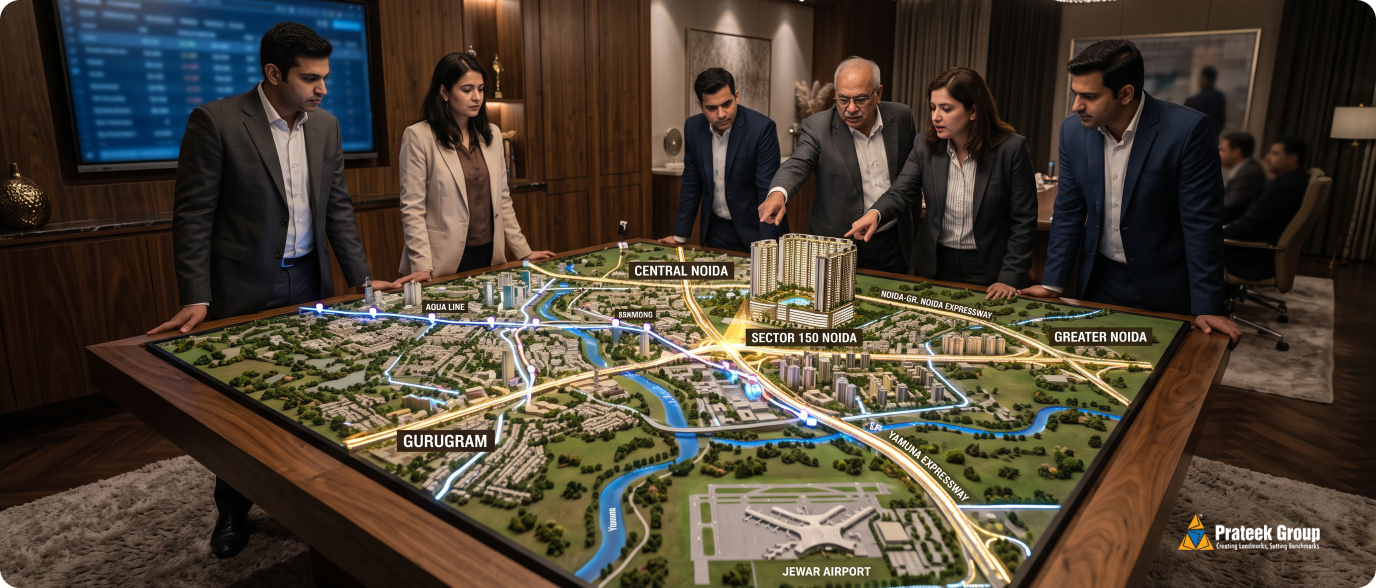
If you have been researching property in Noida over the past year, one sector keeps appearing at the top of every shortlist: Sector 150. It is described as the greenest, most low-density, most future-ready address on the Noida-Greater Noida Expressway. But with prices that have more than doubled since 2021, a complicated registry history that stalled for five years, and significant infrastructure still in delivery, a serious buyer in 2026 deserves a more honest conversation than any brochure can provide.
We have spent considerable time researching the latest transaction data, infrastructure timelines, regulatory developments, and market intelligence to give you a genuinely clear-eyed assessment. This is not a promotional piece. It is the kind of research-backed briefing we would want if we were putting our own money on the line.
The short answer? Sector 150 remains one of the most compelling long-term investment destinations in NCR for 2026, but only if you understand exactly what you are buying into, why it has appreciated, what risks remain, and what the five-year trajectory looks like. Here is the full picture.
TL;DR
Overview: Sector 150, Noida, has emerged as the NCR’s most discussed premium residential address, and this blog evaluates whether it still makes sense to invest in 2026. We examine prices, capital appreciation, infrastructure timelines, rental yields, the Sports City resolution, and the Jewar Airport effect from every angle a serious buyer needs before committing capital.
Core Concern: Prices have already risen 128% since 2021. A five-year registry freeze left 40,000 buyers in legal limbo. Sports City infrastructure went unbuilt by multiple developers. Rental yields sit at a modest 2 to 3%. Is the opportunity already priced in, or does meaningful upside still exist for a buyer entering the market today?
Our Answer: Yes, for the right buyer with a 5 to 10 year horizon. The Jewar Airport was inaugurated on March 28, 2026. The registry ban was formally lifted by the Noida Authority in April 2026 following a Supreme Court directive. Metro expansion is cabinet-approved and funded. The sector’s 80% green cover mandate permanently caps supply. The fundamentals heading into 2026 are stronger than at any previous point in this sector’s history.
Where Property Prices Stand in 2026
Before anything else, let us anchor this conversation in actual numbers. The Sector 150 market has moved significantly over the last three to five years, and the trajectory matters as much as the current price point.
| Price Category | Rate per Sq Ft (2026) |
| Ready-to-move luxury projects | Rs 12,000 to Rs 14,500 |
| Premium under-construction projects | Rs 10,000 to Rs 12,500 |
| Resale units in established communities | Rs 11,000 to Rs 13,500 |
| Ultra-premium towers | Rs 15,000 and above |
| Average quoted base price (ANAROCK Q1 2026) | Rs 14,600 |
To put this in historical context, prices in Sector 150 were hovering around Rs 5,700 per sq ft in late 2021. According to ANAROCK’s residential market research, average values in Sector 150 have risen 128% over the past three years, the highest capital appreciation recorded for any NCR micro-market during that period. This is not a rounding-error kind of outperformance. It is structural, and it is backed by fundamentals we will detail throughout this article.
Separately, the Knight Frank India Real Estate Report for Q1 2026 confirms that Noida posted 8% year-on-year price appreciation in H1 2026, placing it among the stronger-performing residential markets across India’s major cities. Within Noida’s micro-market mosaic, Sector 150 significantly outperforms the city average, reflecting its premium positioning and supply constraints that are baked into the master plan.
Sector 150 commands a 10 to 20% premium over comparable sectors along the same expressway corridor. That premium is not speculative enthusiasm. It is anchored in planning, density controls, green cover mandates, and confirmed infrastructure investment that we will unpack section by section.
Capital Appreciation: What the Data Actually Shows
Capital appreciation is the core investment thesis for Sector 150, and the data holds up to scrutiny in a way that few micro-markets in NCR can match.
| Time Horizon | Approximate Appreciation |
| 1-Year Price Change (2025 to 2026) | + 5.5% to + 9.5% |
| 3-Year Price Change (2022 to 2025) | + 48.8% |
| 5-Year Price Change (2020 to 2025) | + 121.2% |
| Since 2019 (approx. 6 years) | + 100% to + 128% |
| 6-Year CAGR | Approximately 13% to 14% per annum |
According to ANAROCK’s capital appreciation analysis carried in Business Standard, Sector 150 recorded a 128% rise in capital values between late 2021 and end of 2024, compared to rental value growth of 66% during the same period. The divergence is important: it tells you that capital appreciation, not rental income, is the primary wealth-creation engine in this market. Investors who entered for yield would have underestimated the return. Investors who entered for appreciation have been significantly rewarded.
The national macro picture also supports continued momentum. According to the Reserve Bank of India’s All-India House Price Index data published by Outlook Business, residential property prices rose 4.2% year-on-year in the January to March 2026 quarter, accelerating from 3.8% in the same quarter the previous year. This is a national average across 18 cities. Premium micro-markets like Sector 150, backed by confirmed infrastructure and genuinely constrained supply, have historically run well ahead of national averages. The local data above confirms this for Sector 150 specifically.
What does the appreciation mean in actual money? An investor who purchased a 2,000 sq ft flat at Rs 5,700 per sq ft in 2021 paid approximately Rs 1.14 crore. At today’s average of around Rs 13,000 per sq ft, that same unit is now worth approximately Rs 2.6 crore. That is a real-money gain of over Rs 1.4 crore in under four years, before accounting for any rental income earned during possession. The question for a buyer today is not whether past appreciation was real. It was. The question is what drives prices from here. The answer lies entirely in the infrastructure story.
The Infrastructure Story: What Has Arrived and What Is Coming
Sector 150’s value proposition has always been tied to infrastructure delivery. What makes 2026 categorically different from any previous year is that the most significant catalysts have moved from planning documents to physical reality.
Noida International Airport (Jewar): Operational, Not Anticipated
This is the single largest demand driver for the entire expressway corridor. Noida International Airport at Jewar was formally inaugurated by Prime Minister Narendra Modi on March 28, 2026. As confirmed by News on AIR, the official Government of India broadcasting portal, the airport was developed at a total investment of approximately Rs 11,200 crore and is designed as a net-zero emissions facility. Phase 1 capacity stands at 12 million passengers annually.
Commercial domestic flights are expected to begin around mid-2026, with international operations projected to follow by September 2026. Airlines confirmed for Phase 1 include IndiGo, Akasa Air, and Air India Express. Future phases envision up to six runways, eventually making this one of India’s largest airports by capacity. The development planning authority for this corridor, YEIDA — the Yamuna Expressway Industrial Development Authority; has separately launched a residential plot scheme for 2026 targeting the airport influence zone, with 973 plots offered near the new airport. This signals institutional confidence in the corridor’s long-term demand.
For investors in Sector 150, approximately 30 to 40 km from the airport via the Yamuna Expressway, this is no longer a future catalyst. It is an operational reality. History supports the optimism here. Gurgaon’s transformation from a peripheral suburb into one of India’s most expensive residential markets was catalyzed significantly by proximity to IGI Airport. The same dynamic is now playing out along the Jewar corridor, with Sector 150 sitting at the premium residential end of that equation.
The Noida-Greater Noida Expressway: A Live Value Multiplier
Sector 150 sits directly on the Noida-Greater Noida Expressway, one of the most efficiently maintained urban expressways in NCR. According to Business Standard’s June 2026 Noida Expressway luxury corridor report, average housing prices on this corridor rose by 66% over five years, with Sector 150 significantly outperforming this average. The expressway connects residents directly to Delhi’s central business districts, the Yamuna Expressway junction linking to the new airport, and the broader NCR employment belt.
This tri-directional access is rare and genuinely difficult to replicate in new micro-markets. It is one of the core structural reasons why Sector 150 commands a premium and why that premium is sustainable over time. Buyers are not paying extra for proximity to a road. They are paying for access to multiple economic centers from a single address.
Metro Expansion: Appreciation Not Yet Fully Priced In
The Union Cabinet approved an 11.6 km extension of the Noida Metro Aqua Line from Botanical Garden to Sector 142 at an estimated cost of Rs 2,254 crore. Beyond this, a revised DPR by the Delhi Metro Rail Corporation envisions a further 17.43 km extension from Sector 51 to Knowledge Park V via 11 new stations. Both approvals have central government and funding support.
Sector 150 residents currently use the Aqua Line at the Sector 148 metro station, providing connectivity to the Blue Line interchange at Sector 52 and onward to central Delhi. The planned extensions will progressively reduce travel times and open up the corridor to a wider working population as both end-users and tenants. Historical data consistently shows that metro corridor expansions drive 15 to 25% price appreciation in surrounding neighbourhoods once construction becomes visibly underway. This appreciation wave is largely still ahead for the extended Aqua Line corridor, which means investors entering today are positioned ahead of that premium rather than after it.
Sector 150 Sports City: The Complete Picture for 2026 Buyers
This is the part of the Sector 150 story that demands the most careful, honest disclosure. Understanding what happened with Sports City and where it stands today is not optional due diligence. It is foundational.
What Happened: Five Years of Registry Freeze
From January 2021, the Noida Authority froze all flat registries and occupancy certificates across Sector 150. The reason was straightforward: multiple developers had failed to build the mandatory 70% sports infrastructure required under the sector’s Sports City master plan. This affected nearly 40,000 homebuyers who had purchased properties in good faith and were now living in homes they could not legally register or freely resell. For investors, it suppressed resale liquidity. For the sector broadly, it held back full price discovery despite underlying fundamentals that remained strong throughout.
The situation, while deeply frustrating for affected buyers, also meant that Sector 150’s prices remained artificially suppressed relative to the sector’s actual quality for most of this period. Investors who understood the difference between a systemic legal issue and a fundamental value problem and entered during this window have been significantly rewarded as the resolution has unfolded.
The Resolution: Supreme Court Order and April 2026 Registry Revival
Following a Supreme Court directive on November 24, 2025, the Noida Authority was ordered to establish a conditional OC framework for Sector 150. As reported by Pulse of Noida covering the Noida Authority’s April 2026 board meeting in detail, the 222nd Board Meeting of the Noida Authority on April 6, 2026, formally approved the lifting of the registry ban, map approvals, and issuance of OCs for qualifying projects. Developers must pay 20% of outstanding dues within 60 days to access registry clearance.
Separately, as covered by Realty N More’s reporting on the Noida Authority’s April 7, 2026 board decision, the board also approved the revised layout for the long-stalled SC-02 Sports City project. This decision brings formal relief to approximately 20,000 homebuyers awaiting possession or registration. The board simultaneously approved a budget of Rs 10,004 crore for the 2026-27 financial year, with a revenue target of Rs 10,290 crore, signaling strong institutional commitment to completing the sector’s planned infrastructure.
What this means for buyers in 2026: The systemic legal uncertainty that defined Sector 150 for five years is substantially resolved. Registry-ready units have already seen an estimated 15 to 20% price uptick following this news. However, project-level due diligence remains essential. Always verify that the specific project you are considering has cleared its compliance obligations and obtained conditional OC clearance before committing funds. Execution risk at the individual project level has not fully disappeared, even though the sector-wide systemic risk has.
Rental Demand and Yield: Setting the Right Expectations
Rental income from Sector 150 is a secondary benefit, not a primary investment thesis. Setting the right expectation here avoids disappointment and helps buyers evaluate the opportunity accurately.
| Metric | Current Position (2026) |
| Average Rental Yield | 2.0% to 3.0% per annum |
| Average Rental Rate | Approximately Rs 21 per sq ft per month |
| 3-Year Rental Value Growth | + 66% (ANAROCK 2021 to 2024) |
| Tenant Profile | CXOs, NRIs, senior professionals, corporate relocations |
| Primary Investment Driver | Capital appreciation (not rental income) |
A 2 to 3% annual yield is modest compared to commercial real estate or high-occupancy residential markets in other cities. However, this must be read alongside the 128% capital appreciation over three years. The total return on investment, combining capital gains and supplementary rental income, substantially outperforms any pure rental-yield market in NCR over the same period.
Rental demand is also structurally improving. As noted by Global Property Guide citing RBI data and Knight Frank research, urban rental inflation across India’s major metros ran at 7 to 9% annually in H1 2025, with premium micro-markets consistently outperforming. For Sector 150 specifically, rental values grew 66% between 2021 and 2024. As more residents move in following the Sports City OC resolution, as airport-linked corporate demand grows, and as the expressway corridor attracts more commercial activity, the tenant pool will deepen, and rental income will increasingly complement the capital appreciation story.
If rental income as a primary return is your investment goal, there are better-suited markets in NCR. If long-term wealth creation with rental income as a meaningful supplement is what you are seeking, Sector 150 makes a well-supported case.
The Sports City Vision: What 80% Green Cover Actually Means for Investors
No other residential sector in NCR has been master-planned quite like Sector 150. The plan designates 80% of land for green and open spaces, with 70% allocated to sports infrastructure. The result is a density profile that is fundamentally different from anything else in Noida, and this difference directly drives both lifestyle value and investment returns.
- Shaheed Bhagat Singh Park: One of India’s largest urban parks, spread across 40 acres, sits within the sector boundaries.
- 9-hole golf course: A 100-acre golf course is planned and partially underway as part of the Sports City vision.
- Multi-sport training facilities: Cricket academies, football grounds, and integrated multi-sport complexes are part of the approved master plan.
- Underground electricity wiring: Unlike most Noida sectors, power lines run underground, improving both aesthetics and utility reliability.
- Wide internal roads: Planned road widths are significantly larger than standard residential sectors across Noida.
This low-density, high-green-cover model does something that most investors do not immediately appreciate: it permanently restricts future housing supply within the sector. You cannot build additional towers in a location where 80% of the land is legally committed to parks and sports infrastructure under a master plan backed by Noida Authority mandates. This structural supply ceiling is one of the core reasons appreciation has been so strong and why it is likely to continue. Limited land with rising demand is the oldest and most reliable driver of property value in any market.
This is also why premium buyers, specifically HNIs, NRIs, CXOs, and senior professionals, are increasingly treating Sector 150 not as a second-tier alternative to established Gurgaon or Delhi addresses, but as a deliberate first choice. According to Business Standard’s July 2026 analysis of the Noida Expressway as an investment destination, the Noida Expressway corridor’s average quoted base price reached Rs 9,620 per sq ft in Q1 2026, with Sector 150 recording Rs 14,600 per sq ft, underscoring the sector’s clear premium positioning within the corridor.
Supply vs Demand: Why Constrained Inventory Supports Sustained Price Growth

The fundamental principle of lasting real estate value is straightforward: restricted supply meeting rising, genuine demand produces sustained price growth. Sector 150 benefits from both sides of this equation simultaneously and structurally.
Noida’s unsold housing inventory dropped by 72% between 2020 and Q1 2025, a dramatic absorption of overstock that had weighed on the market for years. According to Knight Frank India’s H1 2026 residential market report, homes priced above Rs 1 crore accounted for 54% of total national residential sales in H1 2026, up from 49% in H1 2025. The Rs 2 crore to Rs 5 crore segment, which is where most Sector 150 units sit today, recorded a 43% year-on-year increase in buyer interest. This reflects precisely the buyer segment that Sector 150 is designed for and attracting.
ANAROCK’s Q1 2026 data shows approximately 15,200 residential units sold in the Noida region, representing a 21% year-on-year increase. What is significant about this demand is that it is increasingly end-user-driven rather than speculative. Growing commercial activity along the expressway corridor is creating genuine employment, which in turn attracts buyers who intend to live in and use the homes they purchase, rather than simply waiting to flip them. This end-user base is more durable, less price-sensitive, and more likely to sustain rental demand as well.
The sector’s master plan itself permanently constrains total residential development within Sector 150. No amount of future developer ambition, market demand, or regulatory relaxation can override the 80% green cover mandate without fundamentally altering the sector’s identity. This structural supply ceiling, meeting a rising and increasingly genuine demand wave, creates the conditions for sustained appreciation over a 5- to 10-year horizon.
Sector 150 vs Other Premium Noida Sectors: An Honest Comparison
How does Sector 150 compare to other premium addresses on the Noida Expressway? The answer depends on what you are optimising for. Here is an honest side-by-side.
| Factor | Sector 150 | Sector 137/143 | Sector 128/129 |
| Green Cover | 80% (planned) | 30% to 40% | 20% to 30% |
| Density | Very Low | Medium | Medium-High |
| Avg Price/Sq Ft | Rs 12,000 to Rs 14,600 | Rs 9,000 to Rs 11,000 | Rs 10,000 to Rs 13,000 |
| 3-Year Appreciation | 128% (ANAROCK) | 60% to 80% | 55% to 75% |
| Airport Proximity | 35 to 40 km via Yamuna E. | 45 to 55 km | 50 to 60 km |
| Sports Infrastructure | Mandated (70% of land) | Not planned | Not planned |
| Entry Ticket (3 BHK) | Rs 2.5 Cr to Rs 4.5 Cr | Rs 1.8 Cr to Rs 2.8 Cr | Rs 2.0 Cr to Rs 3.5 Cr |
Sector 150 commands a premium that is justified by measurably superior planning, structurally stronger historical appreciation, and a permanent supply constraint. However, if your budget is below Rs 1.5 crore or if immediate occupancy is a firm requirement, other sectors along the Noida Expressway offer genuine value with reasonable proximity to the same macro infrastructure catalysts. Sector 150 is not the right answer for everyone. But for the premium buyer with a long view, it is difficult to match.
Prateek Canary: Where Premium Positioning Meets Investment Logic
Within Sector 150, project selection matters as much as sector selection. Our project, Prateek Canary in Sector 150 Noida, is one we can speak to with complete depth because we designed and built it. Spanning 12.55 acres with only 664 units across 9 towers of 28 floors each, Prateek Canary maintains a density of just 53 apartments per acre, one of the lowest ratios in the entire sector.
- Configuration: 3 BHK and 4 BHK apartments from 1,700 to 3,355 sq ft, along with duplex penthouses
- Location advantage: Directly off the Noida-Greater Noida Expressway; 5 km from the Yamuna Expressway; close to Sector 148 metro station
- View differentiation: Panoramic golf views on one side; Yamuna and Hindon River views on the other — a dual-view advantage unique in the sector
- RERA registration: UPRERAPRJ591510, fully registered and independently verifiable
- Pricing trajectory: Originally launched at approximately Rs 5,500 per sq ft; current values have moved to approximately Rs 13,000 to Rs 17,000 per sq ft
For buyers who want to verify project registration status independently before any conversation with us, all Sector 150 projects including ours can be verified directly on UP-RERA’s official project registry portal. We actively encourage this step. Transparent verification is the foundation of every buyer relationship we want to build. If you would like to explore our full range of delivered and ongoing residential developments, our complete residential project portfolio at Prateek Group covers premium developments across Noida and NCR, from completed communities to upcoming launches.
Practical Investment Scenarios: What Your Money Can Achieve
Abstract appreciation percentages are useful context. Concrete scenarios help buyers understand what their capital can realistically achieve in Sector 150 over different time horizons.
Scenario 1: Long-Term Capital Appreciation Investor
| Parameter | Details |
| Investment amount | Rs 2.5 crore (under-construction unit) |
| Current price (approx.) | Rs 12,500 per sq ft on 2,000 sq ft |
| Annual appreciation estimate | 10% to 14% per annum (expressway corridor) |
| Projected value in 5 years | Rs 4.0 crore to Rs 4.8 crore (estimated) |
| Supplementary rental income | Rs 50,000 to Rs 70,000 per month post-possession |
| Ideal investment horizon | 5 to 10 years with capital creation as primary objective |
Scenario 2: Premium End-User Buyer
| Parameter | Details |
| Investment range | Rs 3.0 crore to Rs 4.5 crore (ready-to-move) |
| Lifestyle advantage | Low density, 80% green cover, golf course proximity |
| Ongoing cost (approx.) | Maintenance Rs 8,000 to Rs 15,000 per month |
| Capital preservation | Strong (structural supply constraints protect value) |
| Best for | Families prioritising quality of life alongside long-term wealth |
Scenario 3: NRI Investor Building Rupee-Denominated Assets
| Parameter | Details |
| Typical ticket size | Rs 2.0 crore to Rs 5.0 crore |
| Currency advantage | Favourable exchange rates from USD, GBP, AED enhance effective yield |
| Airport corridor benefit | Jewar operational = growing corporate tenant demand nearby |
| Rental income potential | Suitable for premium corporate or HNI tenancy arrangements |
| Best for | NRIs seeking India exposure in an appreciating, premium, supply-constrained asset |
For NRI buyers, our dedicated guide to real estate investment in India for overseas buyers consolidates the key regulatory, tax, and compliance considerations in a format designed for buyers managing the process from abroad.
Investment Risks: What You Must Know Before Buying
Good investment decisions require acknowledging risks as clearly as opportunities. Here is our honest assessment of what remains uncertain in Sector 150 as of 2026.
| Risk Factor | Current Status | How to Mitigate It |
| Registry delays on older projects | Substantially resolved (April 2026 Noida Authority decision) | Verify each project’s compliance status and dues payment before buying |
| Sports infrastructure completion | SC-supervised revival framework underway | Choose RERA-compliant projects from developers with strong delivery track records |
| Under-construction delivery timelines | Developer-specific risk across the sector | Check RERA milestone completion reports and visit the construction site |
| Rental yield below expectations | 2% to 3% is structural, not a defect | Treat rental income as supplementary; the primary thesis is capital appreciation |
| Short-term price correction risk | Low to medium given strong fundamentals | Buy for 5 or more year horizon; avoid expecting quick profitable exits |
| Jewar Airport commercial rollout delays | Substantially reduced (Phase 1 inaugurated March 2026) | Airport is physical; commercial flights expected mid-2026; risk is now execution, not existence |
| Slow commercial development in sector | Commercial hubs are developing gradually | Proximity to DLF Mall, established IT parks, and expressway-fronting services already exists |
The most important risk to manage is at the project level, not the sector level. Sector 150 as a market is fundamentally sound. Individual project selection requires independent due diligence on developer reputation, RERA compliance, construction progress, and outstanding dues payment status with the Noida Authority. Always engage an independent legal advisor, not one recommended by the developer, before transacting.
Who Should Invest in Sector 150 and Who Should Wait
Sector 150 Is the Right Choice For:
- Long-term investors with a 5 to 10 year horizon: The strongest appreciation potential lies ahead as Jewar Airport operations scale, metro extensions reach completion, and Sports City infrastructure fully delivers. Investors entering now are positioned before these catalysts fully reflect in prices.
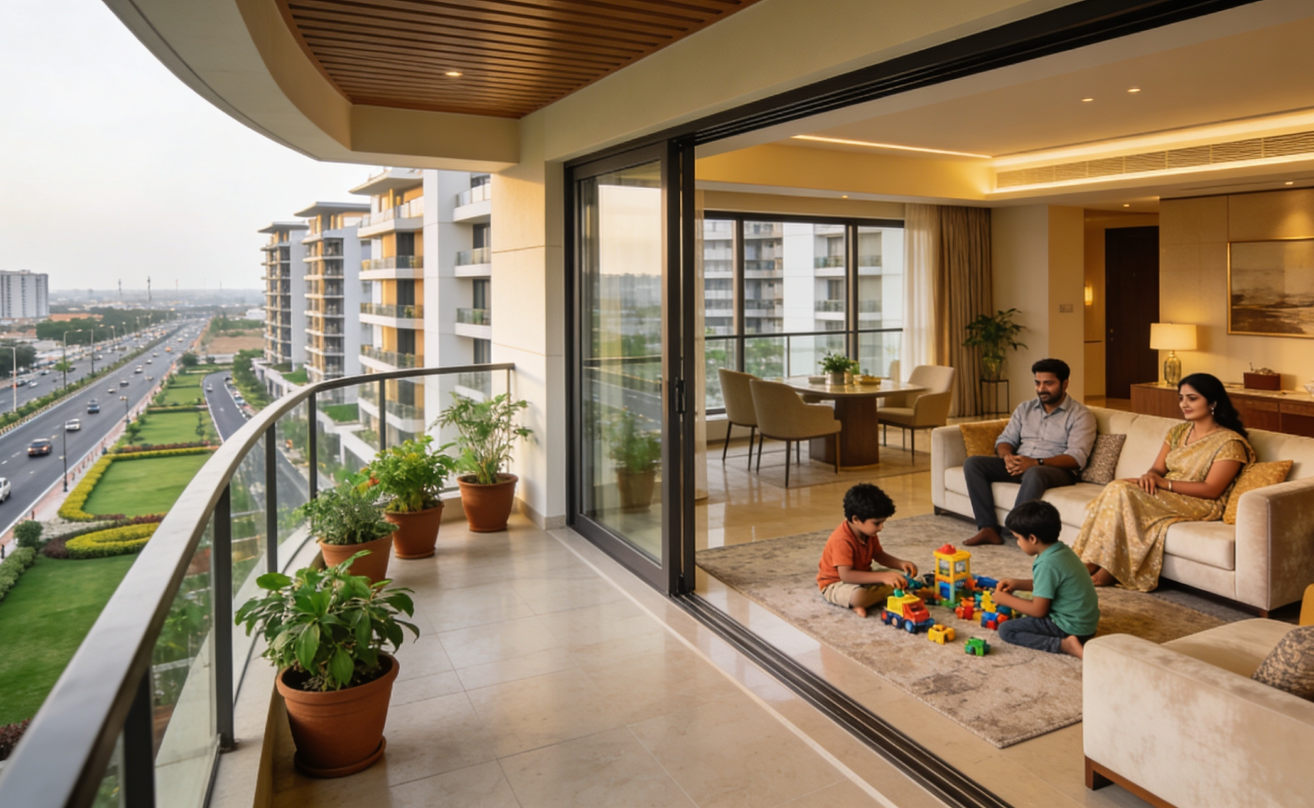
- Premium end-users seeking lifestyle and wealth creation together: Families and professionals wanting low-density living, extensive green cover, and expressway connectivity who also want their primary home to appreciate meaningfully over time.
- HNIs and NRIs: Buyers seeking large-format premium homes in a well-planned, structurally supply-constrained sector with a proven 13 to 14% annual CAGR over six years.
- Portfolio diversifiers: Investors looking to add a capital appreciation-focused real estate asset with strong infrastructure backing to a broader investment portfolio.
Consider Other Options If:
- You need possession within the next 12 months: While ready-to-move units exist, premium under-construction projects carry 2 to 4 year delivery timelines.
- Your budget is below Rs 1.5 crore: Sector 150 is a premium market by design. Comparable construction quality at lower price points exists in Noida Extension or outer sectors of the expressway belt.
- You need high rental yield as your primary return mechanism: At 2 to 3%, Sector 150 is structurally not optimised for yield. Commercial real estate or high-occupancy residential markets in other NCR locations will better serve this specific goal.
- You have a horizon under 3 years and need a specific exit multiple: Premium markets reward patience. Short-term price extraction from a high-base market requires precise timing and carries material risk that long-horizon investing avoids entirely.
Long-Term Outlook: The Case for 2026 to 2031
We believe the next five years represent Sector 150’s most consequential appreciation phase, and the reasoning is specific rather than speculative.
Infrastructure that was once anticipated is now delivering. The Jewar Airport is inaugurated and entering commercial operations. Metro expansion is cabinet-approved with funding in place. The Sports City legal framework is resolved under Supreme Court supervision. The Noida Authority has approved a Rs 10,004 crore budget for 2026-27 with Sector 150’s revival as a stated priority.
ANAROCK’s Q1 2026 data shows the Noida Expressway corridor attracting the highest buyer interest in NCR, with new launches up 44% and sales volumes up 21% year-on-year. The corridor is not approaching the end of its appreciation cycle. It is, in all likelihood, entering its most consequential phase, where infrastructure that was anticipated is now delivering results, and where buyers arriving today are still doing so ahead of full pricing of that infrastructure into property values.
Experts project 10 to 15% annual price appreciation along the Noida-Greater Noida Expressway corridor through 2030, driven by metro expansion, the Jewar Airport corridor, and commercial growth. Sector 150, as the premium micro-market within this corridor with the most defensible supply constraints, is well-positioned to meet or exceed this corridor-level average.
We are also bringing our next premium development to this corridor. Prateek Grand Begonia continues our commitment to low-density, lifestyle-forward residential development in Noida’s most sought-after locations. We build where the data and long-term fundamentals are strongest. Sector 150 and the Noida Expressway corridor remain exactly that.
Practical Due Diligence: A Buyer’s Non-Negotiable Checklist
For any buyer seriously considering Sector 150 in 2026, these steps are mandatory before signing anything.
- Verify UP-RERA registration independently: Check the project’s registration number on the UP-RERA portal to confirm status, approved plans, financial disclosures, and stated possession timelines.
- Confirm registry and OC clearance under the April 2026 framework: Ask specifically whether the project has received Conditional OC clearance following the Noida Authority’s April 6, 2026 board decision.
- Verify developer dues payment: Confirm the developer has paid the required 20% of outstanding dues to the Noida Authority as a prerequisite for registry access.
- Assess physical construction progress: Visit the site personally, assess build quality, and compare actual progress against RERA-registered milestone reports.
- Choose a construction-linked payment plan: Construction-linked plans tie your payments to verified construction milestones, reducing exposure to developer financial stress.
- Engage an independent property lawyer: Not the developer’s recommended solicitor. An independent legal review of all documents, especially the sale agreement and allotment letter, is a non-negotiable protection.
- Calculate total cost of ownership upfront: Factor in GST on under-construction units, stamp duty and registration fees, one-time amenity charges, and recurring monthly maintenance costs before finalising your budget.
To understand how real buyers have navigated the purchase process with us, verified home buyer testimonials at Prateek Group provide honest, first-person perspectives from families across different projects and timelines. Real experiences from real buyers are the most meaningful reference we can offer any prospective buyer.
Myths vs Reality: The Most Common Sector 150 Misconceptions
| Common Myth | Reality in 2026 |
| The registry ban makes Sector 150 too risky | The Noida Authority formally lifted the ban in April 2026 following a Supreme Court directive. Systemic risk is resolved; project-specific compliance still requires independent verification. |
| Prices have already peaked and there is no upside left | ANAROCK Q1 2026 data confirms the corridor is still appreciating. Jewar Airport commercial operations and metro extension construction are upcoming, not behind us. These catalysts are not yet fully priced in. |
| Sports City was a failed experiment that will not recover | The Sports City framework was stalled, not cancelled. It is now in structured revival under Supreme Court supervision, with developer compliance milestones and Noida Authority budget commitment in place. |
| 2 to 3% rental yield makes this a poor investment | Capital appreciation of 128% in three years is the investment thesis. Rental income at 2 to 3% is a secondary, supplementary return on top of significant capital gains. |
| All projects in Sector 150 face the same legal risk equally | Project-level compliance status varies materially. Verify RERA registration, dues payment to the Noida Authority, and OC clearance status independently for each specific project before purchasing. |
Our Honest Verdict: Is Sector 150 Worth Investing in 2026?\

Yes, for the right buyer with the right horizon. The evidence is robust. 128% capital appreciation over three years. Jewar Airport is inaugurated and entering commercial operations. Metro expansion cabinet-approved and funded. Sports City’s legal resolution was achieved through a Supreme Court-supervised framework. A structural supply constraint baked into the master plan that no future development can override. And a national macro backdrop where the RBI’s House Price Index is accelerating and premium urban micro-markets are leading the appreciation cycle.
Sector 150 in 2026 is not an emerging bet. It is a proven market entering its next and most consequential growth phase. The catalysts that were speculative a few years ago are now either fully live or legally committed and underway. The risk profile has improved materially even as the long-term investment opportunity remains genuinely compelling.
That said, it is not a market without nuance. Project-level due diligence is absolutely non-negotiable. Rental yield is not the primary story. And buyers seeking returns over very short horizons should calibrate their expectations carefully or consider other options. But for a premium buyer with a 5 to 10-year view, investing in a quality, RERA-compliant, developer-verified development in Sector 150 today is a well-supported, evidence-based decision.
We at Prateek Group have been building in this region for over two decades. We have delivered communities here, navigated every regulatory cycle alongside our buyers, and built a track record that we are proud to put on the table alongside any investment conversation. We are not asking you to simply take our word for any of this. We are asking you to look at the data, weigh the risks honestly against the opportunity, and make the decision that is right for your specific goals and timeline. If the evidence points you toward Sector 150, we are here to help you navigate it with complete transparency.
FAQs
- Is Sector 150 Noida a good location for first-time homebuyers?
Yes. Sector 150 suits first-time buyers who are looking for a premium lifestyle and long-term capital appreciation rather than immediate rental returns. Buyers should ensure the project is RERA registered, financially stable, and matches their budget before making a purchase.
- How does Sector 150 compare with Greater Noida West for investment?
Sector 150 focuses on premium, low-density living with stronger long-term appreciation potential, while Greater Noida West offers lower entry prices and larger inventory. The better option depends on whether your priority is affordability or long-term capital growth.
- Are there ready-to-move apartments available in Sector 150 Noida?
Yes. Several projects in Sector 150 offer ready-to-move or near-completion apartments. These properties reduce construction risk, allow immediate possession, and are preferred by buyers who want to avoid long waiting periods.
- What is the average apartment size in Sector 150 Noida?
Apartment sizes vary by project. Premium developments generally offer 3 and 4 BHK homes ranging from around 1,700 sq. ft. to over 3,000 sq. ft., while selected projects also provide compact 2 BHK configurations.
- Is buying an under-construction property in Sector 150 safe?
Buying an under-construction property can be safe when the project is RERA registered, has visible construction progress, and is being developed by a reputed builder with a strong delivery history. Always verify approvals and payment schedules before booking.
- Which factors influence property prices in Sector 150 Noida the most?
Property prices are mainly influenced by infrastructure development, project density, developer reputation, green surroundings, metro connectivity, airport accessibility, and the legal status of the individual project rather than the sector alone.
- Can NRIs buy property in Sector 150 Noida?
Yes. NRIs can purchase residential property in Sector 150 under FEMA guidelines. They should review taxation, payment methods, documentation requirements, and appoint a reliable legal advisor before completing the transaction.
- Does Sector 150 have good social infrastructure?
The sector continues to improve its social infrastructure with nearby schools, hospitals, shopping centres, sports facilities, and expanding commercial developments. Residents also benefit from excellent connectivity to neighbouring sectors for daily conveniences.
- How important is RERA verification before investing in Sector 150?
RERA verification is one of the most important steps before purchasing any property. It confirms project registration, approved timelines, construction progress, and regulatory compliance, helping buyers reduce legal and financial risks.
- What maintenance costs should buyers expect in Sector 150?
Maintenance charges differ by project, depending on amenities, clubhouse facilities, landscaping, and security services. Buyers should request the complete maintenance schedule along with the total cost sheet before booking.
- Is Sector 150 suitable for luxury homebuyers?
Yes. Sector 150 is widely regarded as one of Noida’s premium residential destinations because of its low-density planning, expansive green spaces, luxury developments, and proximity to major infrastructure projects.
- What documents should be checked before booking a flat in Sector 150?
Buyers should verify the RERA registration, sanctioned building plans, land ownership documents, occupancy certificate status where applicable, payment schedule, builder-buyer agreement, and any Noida Authority approvals related to the project.
- Will the Noida International Airport increase property demand in Sector 150?
The operational airport is expected to strengthen long-term demand by improving regional connectivity, attracting businesses, and increasing employment opportunities. However, appreciation will continue to depend on overall infrastructure growth and project quality.
- How can buyers compare different projects in Sector 150 effectively?
Instead of comparing only prices, buyers should evaluate project density, developer reputation, construction quality, possession timelines, carpet area, legal approvals, amenities, and long-term resale potential before making a decision.
- Why do premium projects in Sector 150 command higher prices?
Premium projects typically offer lower density, larger apartments, superior landscaping, better construction quality, extensive amenities, and stronger long-term appreciation potential, all of which justify higher pricing compared to conventional residential developments.




Leave a Reply