
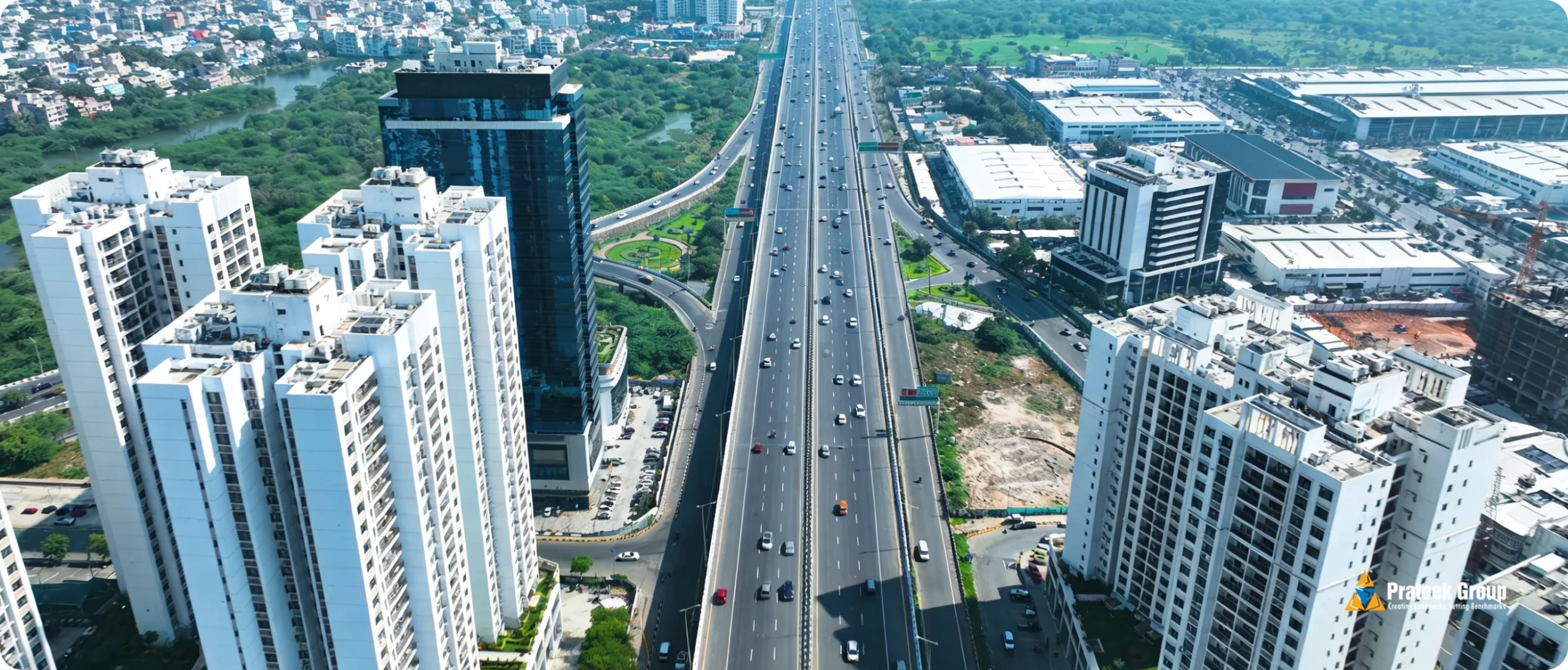
Ask any NCR home buyer: what pushed prices in the last few years? and one answer keeps coming back: a road.
Sometimes it’s Dwarka Expressway. Sometimes it’s the Yamuna Expressway. Sometimes it’s NH-9, UER-II, or a new metro link. Now, the Delhi-Katra Expressway has entered the same property conversation, especially for buyers tracking North and North-West NCR.
The project is big enough to deserve attention. The Delhi-Amritsar-Katra Expressway is a 669 km greenfield expressway being built at an estimated cost of ₹40,000 crore, according to the source: Press Information Bureau. Once ready, it is expected to cut Delhi to Amritsar travel to about 4 hours and Delhi to Katra travel to about 6 hours.
But NCR real estate rarely reacts only to distance. It reacts to usable access. A road becomes serious for property buyers when it changes daily movement, weekend travel, business routes, warehousing plans, and developer interest.
That is where the Delhi-Katra Expressway impact on real estate gets interesting.
For Delhi NCR, the first property effect may be seen around the northern and western edges: Kundli, Sonipat, Bahadurgarh, Jhajjar, Rohini Extension, and parts of outer Delhi. These areas already sit close to major movement corridors like KMP Expressway, NH-44, and Delhi-Haryana border zones.
The expressway gives them a stronger reason to enter the buyer’s shortlist.
And that matters because buyers in NCR have become practical. They don’t only ask, “How far is it from Delhi?” They ask, “How quickly can I get out? How bad is the traffic? Is the road actually ready? Is the location liveable today?”
A future expressway can pull attention, but a good property decision still depends on the project, nearby schools, hospitals, markets, internal roads, drainage, safety, and resale demand.
So the real question is simple: will the Delhi-Katra Expressway create the same pull for North and North-West NCR that other big corridors created elsewhere? Probably, but unevenly.
Some pockets may move faster. Some may stay stuck in hype. The smart buyer will know the difference.
Delhi Katra Expressway route: the map looks simple, the property story doesn’t
The Delhi Katra Expressway route is being planned as a major access-controlled corridor connecting Delhi with Amritsar and Katra. Source: NHAI’s annual report describes the corridor as a 670 km Delhi-Amritsar-Katra Expressway under Bharatmala Pariyojana, connecting the National Capital with Amritsar in Punjab and Katra in Jammu and Kashmir.
On paper, the route feels clean.
Delhi side movement links with the Haryana belt, then the expressway moves through Punjab before reaching Jammu and Kashmir. PIB says the route includes 137 km in Haryana, 399 km in Punjab, and 135 km in Jammu and Kashmir.
For a traveller, this means shorter trips to Punjab and Vaishno Devi.
For a property buyer, the story sits closer to Delhi.
The Delhi-Katra Expressway influence on NCR will likely begin near access points, junctions, and feeder routes. Locations that can connect cleanly to the corridor may get more attention than places that are “near” it only on a map.
That difference matters.
A project can advertise expressway proximity, but the buyer still has to check the real drive time from the gate to the entry point. A 10 km stretch with poor internal roads can feel longer than 25 km on a clean corridor. NCR buyers have learnt this the hard way in several developing belts.
Here is the route story in a simpler property lens:
| Route layer | What it means for Delhi NCR property buyers |
| Delhi-Haryana side | Stronger focus on North-West Delhi, Kundli, Sonipat, Bahadurgarh, and nearby belts |
| Punjab stretch | Better long-distance movement for trade, travel, and logistics |
| Jammu and Kashmir link | Stronger religious tourism and highway movement towards Katra |
| KMP-side influence | More attention on land, plotted housing, warehousing, and peripheral NCR markets |
| Feeder roads | The real deciding factor for residential buyers |
There is one more point buyers should track: timeline.
Recent reports suggest parts of the expressway have faced delays, especially in Punjab. The Tribune reported in May 2026 that NHAI terminated 3 Delhi-Amritsar-Katra packages because of issues including land acquisition and fly ash-related problems, with tenders being floated again for the remaining work.
The project timeline still matters.
People who bought early on Dwarka Expressway saw years of delay before the corridor became a stronger market trigger. A similar patience test can happen around any large road project. The Delhi NCR property market rewards early reading, but it punishes blind buying.
So, when someone says “property near Delhi Katra Expressway,” the next questions should be:
Which access point? Which road? Which builder? Which possession timeline? Which resale market?
That is where the real research starts.
Once the route is clear, the bigger question begins: which parts of NCR actually gain from it?
Delhi-Amritsar-Katra Expressway project facts buyers should read carefully
Before anyone says, “Buy now, prices will shoot up,” pause for a minute.
Have you checked what is actually being built? How long is the corridor? Which states does it pass through? Is the NCR benefit direct, or does it depend on feeder roads and nearby infrastructure?
These questions matter because a lot of property decisions near new highways are made on half-information.
The Delhi-Amritsar-Katra Expressway is a 669 km greenfield expressway. The government has estimated the project cost at around ₹40,000 crore. Once completed, it is expected to reduce Delhi to Amritsar travel to about 4 hours and Delhi to Katra travel to about 6 hours. The current Delhi-Katra distance is around 727 km, and the new route is expected to cut it by 58 km. (https://www.dailyexcelsior.com/)
Now, what does that mean for the Delhi NCR property market?
It means the corridor can make North and North-West NCR more visible to buyers who earlier looked mostly at Noida, Gurugram, Greater Noida, or Ghaziabad. Visibility can start the conversation. Access, habitability, and actual demand decide the result.
Here’s the clean version.
| Project fact | What buyers should read from it |
| 669 km greenfield expressway | Large regional corridor, not just a local NCR road |
| Approx. ₹40,000 crore cost | Serious public infrastructure investment |
| Delhi-Amritsar travel target: 4 hours | Better long-distance movement towards Punjab |
| Delhi-Katra travel target: 6 hours | Stronger religious tourism and highway movement |
| Haryana, Punjab, J&K coverage | Wider northern growth corridor |
| NCR-side influence | Likely stronger around access-led pockets, not every nearby village |
So, should a buyer rush into property near Delhi Katra Expressway?
Ask this first: is the property close to a usable entry point, or is the sales pitch only showing a thick red line on a map?
That one question can save years of regret.
A family buying for end-use should check schools, hospitals, markets, security, drainage, and internal roads. An investor should check resale depth, rental demand, developer credibility, and how much of the price already includes “future expressway premium.”
The corridor story becomes stronger when the project and the locality make sense even without the hype. If the area has poor civic services, weak resale demand, and unclear access, the expressway alone can’t carry the investment case.
A buyer once put it very simply during a site visit discussion: “Roads can come late, but my possession date can’t.” That is how serious NCR buyers think now. They don’t only compare location and price. They compare delivery history. In markets where several builders have overpromised on timelines, names such as Prateek Group and Godrej often enter the serious-consideration list because buyers associate them with stronger delivery discipline and long-term trust. Prateek Group’s own website says the company was incorporated with a vision of quality and on-time delivery, while its about page mentions a proven track record of on-time deliveries. Godrej Properties, meanwhile, has a large national development presence across 15+ cities, which keeps it high in buyer recall when people compare reputed developers. (prateekgroup.com, prateekgroup.com, godrejproperties.com)
That is the first filter buyers should use before entering any highway-linked market.
How the Delhi-Katra Expressway impact on real estate may actually play out in NCR
So, will the Delhi-Katra Expressway impact on real estate be instant?
Any broker promising an overnight price jump is selling urgency, not insight.
Real estate near large corridors usually moves in stages. First, the road gets announced. Then landowners raise expectations. Then developers test demand. Then buyers enter seriously, but only when the road becomes usable and the location starts feeling liveable. After that, weak locations get exposed.
We have seen this before.
Look at Dwarka Expressway. Property prices along the corridor nearly doubled from ₹9,434 per sq. ft. in 2020 to ₹18,668 per sq. ft. in 2024, according to a PropEquity study reported by The Times of India. The same report linked the price jump to better connectivity, completion progress, and stronger access to Delhi and IGI Airport.
Look at Yamuna Expressway too. The Economic Times reported that between 2020 and 2025, apartment prices along the Yamuna Expressway rose by 158%, while plot values rose by 536%, largely because Jewar Airport changed buyer expectations in that belt. (m.economictimes.com)
Now ask yourself: did those markets grow only because a road existed?
Of course not.
They grew because the road connected with a bigger story: airport access, employment zones, commercial movement, developer activity, and buyer confidence.
Dwarka Expressway shows what happens when a delayed corridor finally becomes usable. Yamuna Expressway shows what happens when one major infrastructure project pulls an entire region into investor attention. The Delhi-Katra Expressway may sit somewhere between the two.
The first NCR winners will likely be locations that already have 4 things working together:
- Real access: near a usable entry or feeder road.
- Daily-use infrastructure: schools, healthcare, retail, fuel pumps, public transport, and basic civic services.
- Business movement: warehousing demand, logistics parks, industrial areas, and truck movement.
- Liveable housing supply: projects with legal clarity, possession confidence, and proper society planning.
This is why NCR real estate growth around the Delhi-Katra Expressway should be read carefully.
Kundli may react differently from Sonipat. Bahadurgarh may gain more from logistics than premium housing. Rohini Extension may benefit from better outward movement, but its demand pattern will differ from a direct access belt.
And what about buyers already comparing Noida, Ghaziabad, and Delhi NCR corridors?
That comparison is fair. Recent NCR coverage shows how highway-led access can change market perception. For example, The Times of India recently reported that NH-9 connectivity has played a role in Ghaziabad’s rise as a stronger real estate market, especially as premium residential and commercial activity improves along connected stretches. (timesofindia.indiatimes.com)
The real lesson is simple.
A highway gives an area a chance. The rest depends on planning, access, builder trust, and whether families can actually live there without waiting 10 years for basic convenience.
Delhi NCR property market shift: buyers aren’t chasing distance anymore, they’re chasing usable access

Ask any serious NCR buyer one simple question: “Would you rather live 20 km away with bad roads, or 35 km away with a clean exit route?” Most will choose the second option.
That is why the Delhi NCR property market keeps changing every time a major road becomes usable. Buyers don’t think only in kilometres now. They think in time, traffic pain, airport access, office routes, school runs, and weekend movement.
Would you save ₹20 lakh on a home if it meant losing 45 minutes every day on broken approach roads? Most families won’t.
Cushman & Wakefield’s Q3 2025 Delhi NCR residential report shows the same pattern in another corridor. New Gurgaon and Dwarka Expressway were among the most active submarkets for launches, with New Gurgaon accounting for 23% and Dwarka Expressway for 20% of new residential launches in that quarter. The report also links Dwarka Expressway’s appeal with better access to IGI Airport and changing social infrastructure. (assets.cushmanwakefield.com)
So, what should you watch around the Delhi-Katra Expressway?
1. Is the road changing daily decisions?
A road becomes powerful when families start saying, “This location now makes sense.”
That is when a distant-looking area begins to feel practical. Kundli, Sonipat, Bahadurgarh, and outer Delhi can gain more buyer interest if the expressway connects well with feeder roads, KMP Expressway, UER-II, and NH-44.
2. Is the area liveable today?
This is where many buyers make mistakes.
A future corridor can create interest, but families still need schools, grocery stores, hospitals, power backup, security, drainage, and decent internal roads. Without that, the property may look good in a brochure and feel tiring in daily life.
Mature NCR pockets usually hold buyer confidence better because the daily-use layer is already present. Newer belts need time to build that comfort.
3. Are businesses moving too?
Residential demand becomes stronger when commercial movement follows.
Warehousing, logistics parks, small offices, highway retail, fuel stations, repair hubs, and transport businesses can change the rhythm of a belt. Once daily employment and business activity rise, housing demand usually gets deeper.
That is why NCR real estate growth around the Delhi-Katra Expressway should be read through people and business movement, not only through project advertisements.
The buyer who tracks access, liveability, and job-side demand will read this market better than the buyer who only reads “near expressway” on a hoarding.
Areas in Delhi NCR likely to benefit from the Delhi-Katra Expressway
Now let’s get practical.
If the Delhi-Katra Expressway does change real estate demand around NCR, which areas should actually be watched?
Here is a cleaner way to read it.
| Area | Why buyers may track it | Best-fit property demand |
| Kundli | Close to Delhi border, KMP access, industrial presence, and stronger highway movement | Apartments, plots, rental housing |
| Sonipat | Wider land availability, education hubs, industrial base, and better regional access | Plotted homes, mid-range housing, long-term investment |
| Bahadurgarh | Better movement through outer Delhi, UER-II influence, and industrial activity | Warehousing-linked housing, budget homes, plots |
| Jhajjar | More land depth and logistics potential | Industrial land, warehousing, early-stage investment |
| Rohini Extension | Delhi-side buyer spillover and better outward access | Family housing, builder floors, apartments |
| North-West Delhi | Stronger movement towards Haryana, Punjab, and airport-linked routes | End-use housing and small business-led demand |
The Sonipat-Kundli belt deserves special attention because it sits close to Delhi and also connects with larger road networks. The Economic Times reported that infrastructure upgrades such as Dwarka Expressway and UER-II are expected to help outer Delhi and nearby areas like Sonipat, Panipat, and Kundli, mainly as central locations become expensive for many buyers. (economictimes.indiatimes.com)
UER-II also matters here.
A Times of India report said the Alipur-Dichaon Kalan stretch of UER-II was inaugurated with the Delhi section of Dwarka Expressway in August 2025, and the projects were built to ease NCR traffic and improve links towards places such as Bahadurgarh and Sonipat. (timesofindia.indiatimes.com)
So, where does property near Delhi Katra Expressway become more interesting?
Start with locations where 3 things overlap:
- The road link is real and usable.
- Daily life already has some support systems.
- Prices have room to grow without becoming unrealistic.
That is why Kundli and Sonipat may get earlier attention than many distant pockets. Bahadurgarh and Jhajjar may see a different type of demand, more linked to land, logistics, and industrial movement.
North-West Delhi and Rohini Extension sit in another category. They may benefit from better exit routes rather than direct corridor-led development.
Here is another way to read the market.
| Buyer type | Markets to watch | Why it may fit |
| End-user | Sonipat, Rohini Extension, North-West Delhi | Better family housing options and road access |
| Investor | Kundli, Sonipat, KMP-side pockets | Lower entry cost and future corridor value |
| Business buyer | Bahadurgarh, Jhajjar, Rai-Barhi belt | Warehousing and industrial movement |
| Long-term land buyer | Select Haryana-side pockets | Land depth and future access value |
But, 2 names need a closer look: Sonipat and Kundli.
Sonipat real estate and Kundli property market: why the early noise is coming from here?
Want to know where the Delhi-Katra Expressway story feels most serious near NCR?
Start with Sonipat and Kundli.
Both markets already sit close to Delhi, KMP Expressway, NH-44, industrial belts, and the Haryana side of the larger corridor. That makes them more interesting than places that only have “future growth” written on a sales brochure.
Sonipat real estate has 2 things buyers usually like: land depth and improving access. Families looking beyond Delhi’s pricing pressure already study this belt for plots, builder floors, and mid-range apartments. Investors look at it differently. They track road movement, industrial activity, and how quickly social infrastructure catches up.
Kundli is even more direct in its NCR appeal. Current listings show the average flat rate in Kundli, Sonipat at around ₹4,600 per sq. ft., according to 99acres. Square Yards puts Kundli’s average asking price at around ₹4,436 per sq. ft., with apartments showing about 15.25% average price growth. (99acres.com)
So here’s the real buyer question: is this still an affordable entry point, or has the market already priced in too much future hope?
That answer changes from project to project.
The Kundli property market looks better when the property has clean access, legal clarity, nearby daily-use services, and a sensible price compared with resale options. A weaker project, even near a big road, can still become a slow-moving asset.
Sonipat and Kundli may benefit early from the Delhi Katra Expressway route, but buyers should avoid treating both markets as one single block. Kundli is more Delhi-border driven. Sonipat has a wider city and industrial growth story.
| Market | What makes it worth watching | What buyers should check |
| Sonipat | Wider land supply, industrial base, education pockets, improving road links | Sector, access road, resale demand, civic services |
| Kundli | Delhi-side proximity, KMP link, NH-44 movement, lower entry pricing than core NCR | Project status, builder record, rental demand, traffic load |
| Rai-Barhi belt | Industrial and warehousing activity | Land-use status, title clarity, long-term demand |
| KMP-side pockets | Better regional movement | Last-mile road quality and actual entry distance |
The strongest case for these markets comes when connectivity, liveability, and price still make sense together.
The Delhi-Katra Expressway can pull attention here. But attention alone doesn’t make a good investment. The numbers, access, and ground reality still need to agree.
Property near Delhi Katra Expressway: what should you check before putting money down?

A lot of buyers will hear one line over the next few months: “Sir, this property is near the Delhi-Katra Expressway.”
Sounds good.
But near where?
Near an access point? Near a service road? Near a future road that still needs land clearance? Or just near the broad corridor on Google Maps?
That difference matters because property near Delhi Katra Expressway can perform very differently from one pocket to another. A home 8 km from a clean entry road may be better than a cheaper plot that needs 25 minutes through broken internal roads.
If you had to resell this property after 5 years, who would buy it from you?
That question is uncomfortable, but useful.
Use this checklist before you believe the sales pitch.
| What to check | Why it matters |
| Actual entry distance | Map distance and driving distance are often different |
| Last-mile road condition | Poor internal roads reduce daily comfort |
| RERA registration | Helps verify project details and timelines |
| Land-use status | Important for plots and developing belts |
| Civic services | Water, drainage, power, and security decide liveability |
| Resale demand | A good buy should have future exit options |
| Rental market | Useful for investors who want income |
| Nearby social infrastructure | Schools, clinics, shops, and transport matter more than slogans |
One more point: track the project timeline.
The Economic Times reported in February 2026 that the Delhi-Katra Expressway is now expected to be completed by March 2027, with the route reducing Delhi-Katra distance from 727 km to 588 km and travel time from about 14 hours to around 6 hours. (m.economictimes.com)
The Tribune also reported in May 2026 that NHAI terminated 3 packages of the Delhi-Amritsar-Katra Expressway because of issues including land acquisition and fly ash problems, with fresh tenders being floated for the remaining work. (tribuneindia.com)
That means buyers need patience.
The expressway impact on property prices may be real in stronger pockets, but it may arrive in phases. Some areas will rise early because of speculation. Some will rise later when access becomes usable. Some may stay stuck if local infrastructure doesn’t improve.
A good buyer reads all 3 layers: road, locality, and project. Skip any property where only the road story sounds strong.
Conclusion: Delhi-Katra Expressway can shift NCR growth, but smart buyers will look beyond the road
The Delhi-Katra Expressway can change how buyers look at North and North-West NCR.
Kundli, Sonipat, Bahadurgarh, Jhajjar, Rohini Extension, and outer Delhi may all gain attention in different ways. Some markets may attract homebuyers. Some may attract logistics and warehousing demand. Some may see land prices move first, then housing demand later.
But one rule stays the same in NCR real estate: a road can bring attention, but liveability keeps demand alive.
So don’t buy a location only because it appears near the Delhi-Amritsar-Katra Expressway. Check the access road. Visit the area at different times. Compare resale prices. Study the builder record. Look at schools, clinics, markets, drainage, and public transport.
For buyers comparing infrastructure-led NCR markets, Prateek Group can work as a useful reference point for how connectivity, planning, and daily convenience shape long-term housing demand across established NCR pockets. The same is true when buyers compare reputed developers such as Godrej in markets where delivery confidence matters as much as location. The point is simple: a future road can create interest, but a dependable builder record gives buyers the confidence to stay invested through the waiting period.
The Delhi-Katra Expressway may not change NCR overnight. Roads rarely do.
But they quietly change how people move, where businesses open, and which locations buyers begin to trust. That is where the real property story starts.
FAQs on Delhi-Katra Expressway and NCR real estate growth
1. What is the Delhi-Katra Expressway?
The Delhi-Katra Expressway is a major road corridor connecting Delhi with Amritsar and Katra. The government has described it as a 669 km greenfield expressway with an estimated cost of ₹40,000 crore. It is expected to reduce Delhi-Amritsar travel to about 4 hours and Delhi-Katra travel to about 6 hours. (pib.gov.in)
2. What is the Delhi Katra Expressway route?
The Delhi Katra Expressway route links Delhi with Haryana, Punjab, and Jammu and Kashmir. PIB says the corridor includes about 137 km in Haryana, 399 km in Punjab, and 135 km in Jammu and Kashmir. The NCR-side effect will likely be stronger near access points and feeder roads. (pib.gov.in)
3. Is the Delhi-Katra Expressway open now?
The full corridor is still under development. Recent reports suggest the timeline has moved, with some packages facing delays. The Economic Times reported in February 2026 that NHAI expects the Delhi-Katra Expressway to be completed by March 2027. (m.economictimes.com)
4. Which cities are connected by the Delhi-Amritsar-Katra Expressway?
The Delhi-Amritsar-Katra Expressway connects Delhi with Amritsar and Katra, while improving access across several parts of Haryana, Punjab, and Jammu and Kashmir. NHAI describes it as a corridor that improves connectivity to cities such as Chandigarh, Mohali, Sangrur, Patiala, Ludhiana, Jalandhar, and Kapurthala. (nhai.gov.in)
5. Does the Delhi-Katra Expressway pass through Sonipat?
The wider NCR-side influence is closely linked with the Haryana belt and nearby road networks, but buyers should check exact access points before assuming direct benefit. Sonipat real estate may gain attention because of its proximity to Delhi, KMP Expressway, NH-44, industrial movement, and improving regional access.
6. Will the Delhi-Katra Expressway increase property prices in Delhi NCR?
The Delhi-Katra Expressway impact on real estate may be stronger in well-connected pockets such as Kundli, Sonipat, Bahadurgarh, and parts of outer Delhi. Price growth will depend on access points, local infrastructure, project quality, and actual buyer demand.
7. Which Delhi NCR areas may benefit from the Delhi-Katra Expressway?
Kundli, Sonipat, Bahadurgarh, Jhajjar, Rohini Extension, North-West Delhi, and outer Delhi pockets may benefit in different ways. Kundli and Sonipat may see stronger housing interest, while Bahadurgarh and Jhajjar may gain from industrial and logistics-linked demand.
8. Why is the Kundli property market being discussed with this expressway?
The Kundli property market is close to Delhi, KMP Expressway, NH-44, and industrial areas. 99acres currently lists flat prices in Kundli, Sonipat in the range of ₹3,850 to ₹5,700 per sq. ft., which keeps it more affordable than several core NCR markets. (99acres.com)
9. Is property near Delhi Katra Expressway good for investment?
Property near Delhi Katra Expressway can be a good long-term option if the location has real access, legal clarity, RERA registration, basic services, and resale demand. Buyers should avoid paying a high premium only because a project is marketed as expressway-facing.
10. What should buyers check before buying near the expressway corridor?
Check the actual entry distance, last-mile road, RERA details, land title, local services, resale activity, rental demand, and the current project stage. A property that looks close on a map may still be weak if the daily access is poor.




Leave a Reply